Oct 7, 2026
From Rakwana Rough to Matching Trilliant Sapphires: A Ceylon Sapphire Sourcing and Cutting Journey
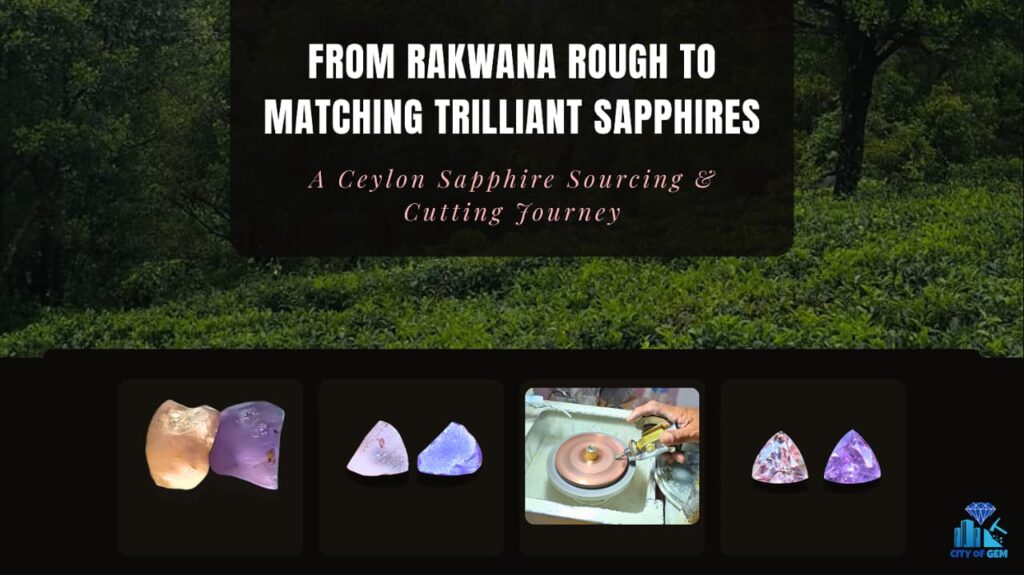
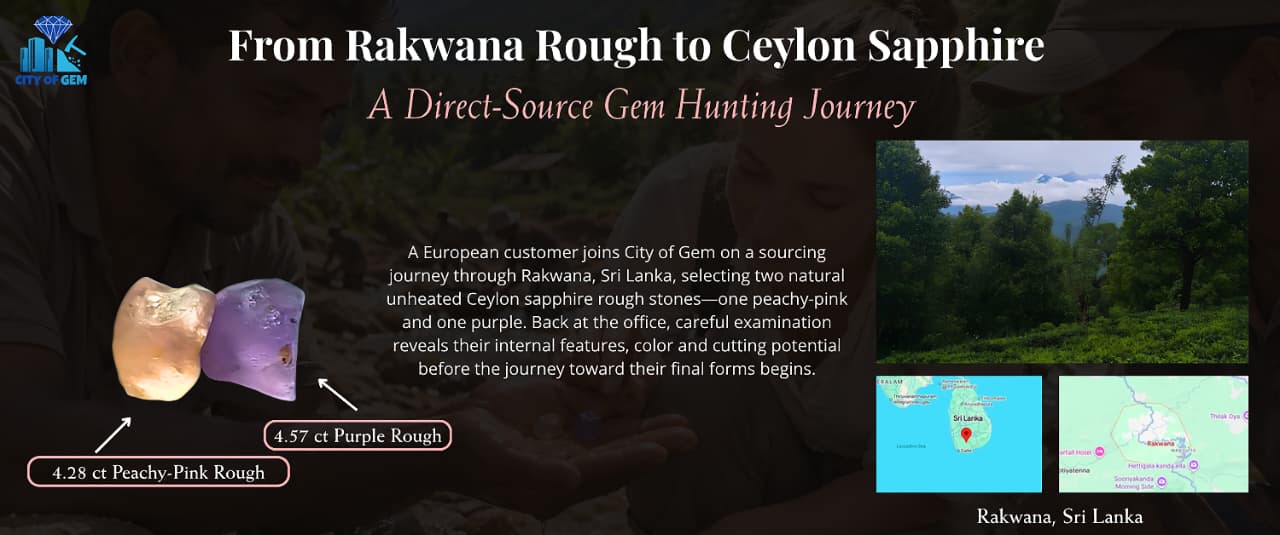
Another City of Gem sourcing journey began in Rakwana, Sri Lanka, when one of our European customers joined us for a gemstone hunting trip close to the gem-producing villages of the area. Rather than beginning with a finished gemstone, this journey started at the source, where natural sapphire rough could be examined, discussed and selected together.
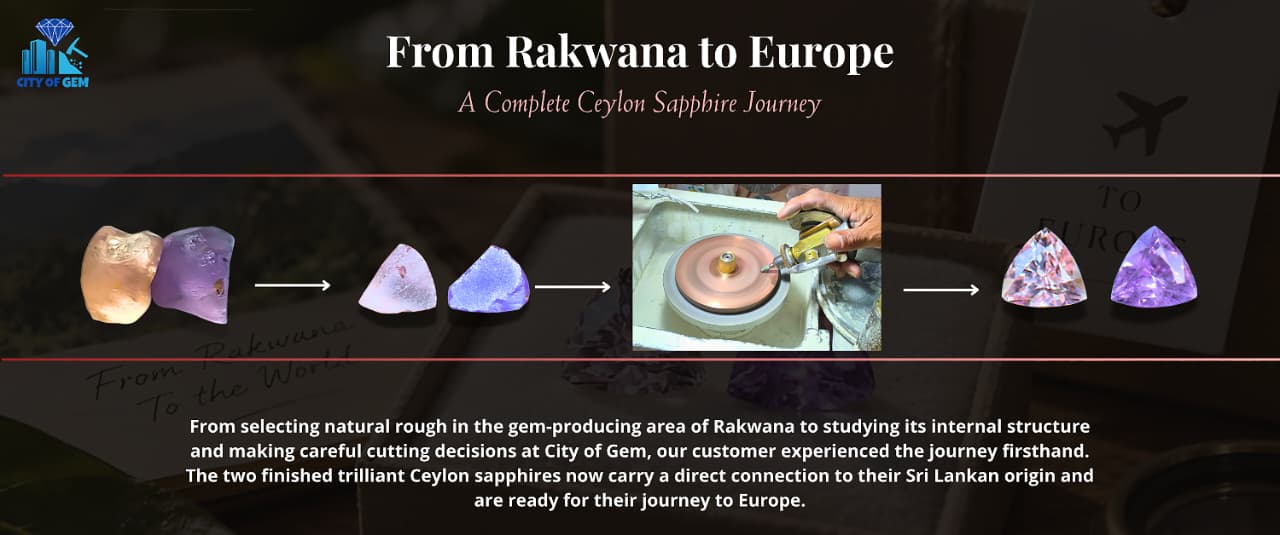
During the sourcing trip, we purchased two natural unheated Ceylon sapphire rough stones: one showing an attractive peachy-pink body color and the other displaying a purple sapphire color. Both were alluvial rough sapphires, naturally shaped by their geological journey before reaching the gem-bearing gravels of Sri Lanka.
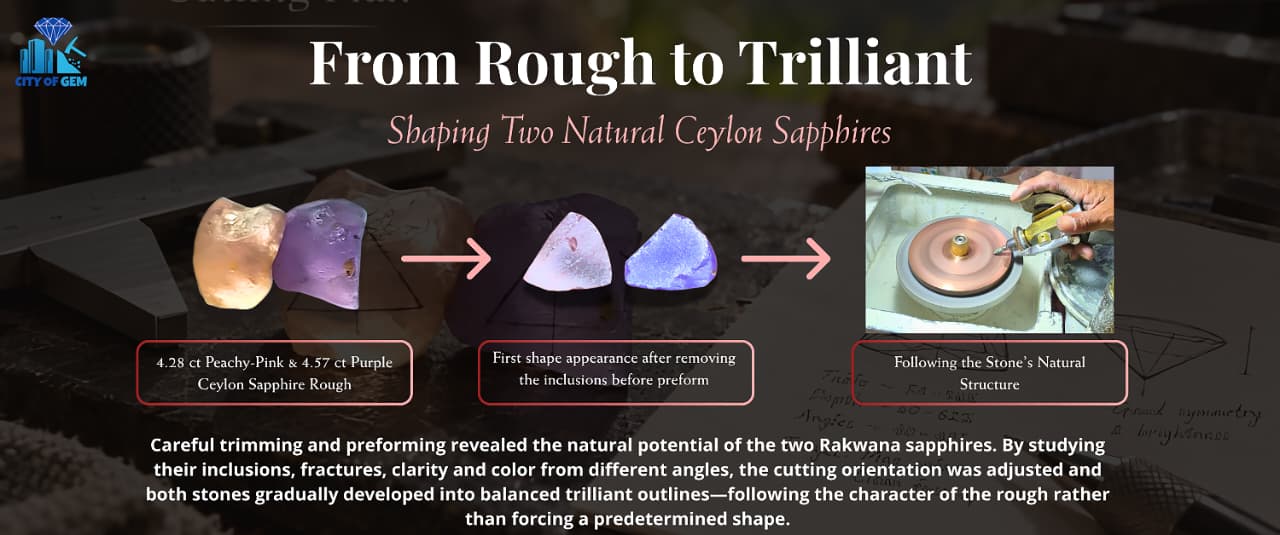
The peachy-pink sapphire rough weighed 4.28 ct, while the purple sapphire rough weighed 4.57 ct. At this stage, the final shape, clarity and finished weight could not simply be decided from the outside. Rough sapphire always requires careful examination because internal feathers, fractures, crystal inclusions, color zoning and hidden structural features can influence the final cutting result.
After completing our gem hunting trip, we returned to the City of Gem office with our customer and began studying both stones more carefully. This is an important part of our direct-source cutting process. Instead of immediately placing the rough on the cutting wheel, we first examined the internal structure, transparency, color direction and possible cutting orientations.
The goal was not only to retain as much weight as possible. For these stones, the more important objective was to find the correct balance between clarity, face-up color, proportions and overall beauty.
We then switched on the gemstone trimming and grinding equipment and gradually started removing areas that would not contribute positively to the finished gemstones. Both sapphires contained natural internal features, including feathers, fractures and small crystal inclusions. These are normal characteristics that can occur in natural alluvial sapphire rough, but their position determines how carefully the cutter must plan the stone.
During preforming, we continuously checked the sapphires from different angles. Certain areas were removed to improve clarity, while the orientation was adjusted to help bring the most attractive color into the face-up appearance.
As the unnecessary rough material was removed, both stones began to reveal a natural trillion-style outline. Rather than forcing the material into a shape that would require excessive weight loss, we followed the structure of the rough and developed each stone toward a well-balanced trilliant cut.
This is one of the practical advantages of cutting directly from individually selected rough. The design can be adapted to the gemstone instead of making the gemstone conform to a predetermined shape regardless of its internal structure.
The 4.28 ct peachy-pink sapphire rough eventually produced a 1.18 ct finished trilliant sapphire, measuring approximately 6.2 × 6.2 × 4.1 mm.
The finished-weight recovery was approximately 27.6%.
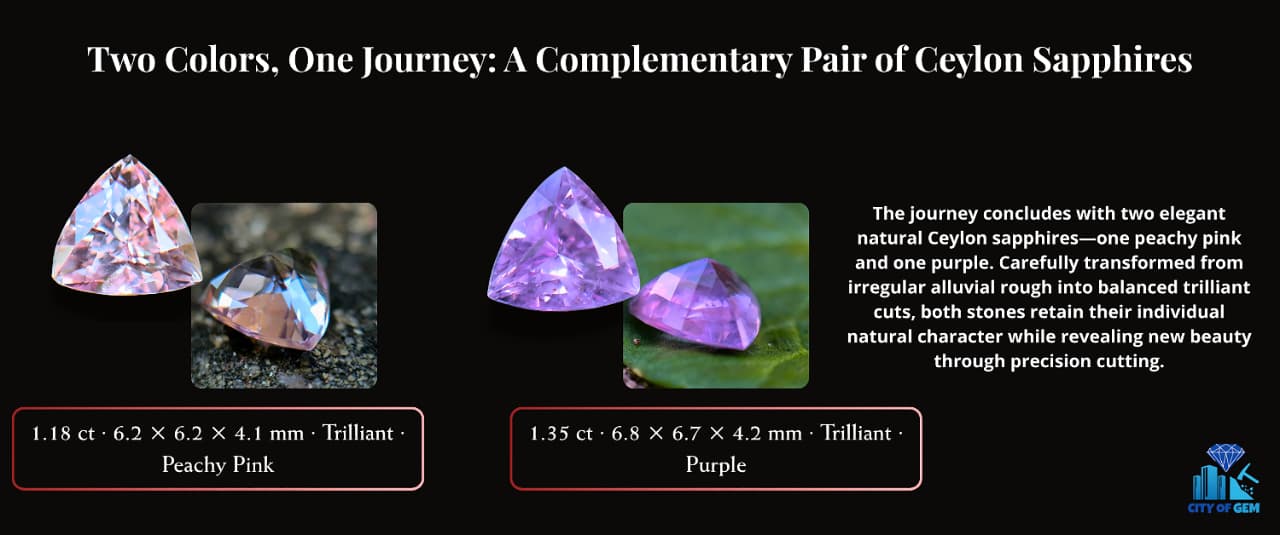
In other words, around 72% of the original rough weight was removed during trimming, inclusion management, preforming and final faceting. Although this may initially appear to be a large weight reduction, sapphire cutting is not simply about preserving carats. Keeping fractured, included or poorly oriented areas can reduce brilliance, weaken the stone or negatively affect the final face-up appearance.
The second stone, a 4.57 ct natural purple sapphire rough, produced a 1.35 ct finished trilliant sapphire, measuring approximately 6.8 × 6.7 × 4.2 mm.
Its finished-weight recovery was approximately 29.5%.
Together, the two rough sapphires originally weighed 8.85 ct. Their combined finished weight is 2.53 ct, giving an overall cutting recovery of approximately 28.6%.
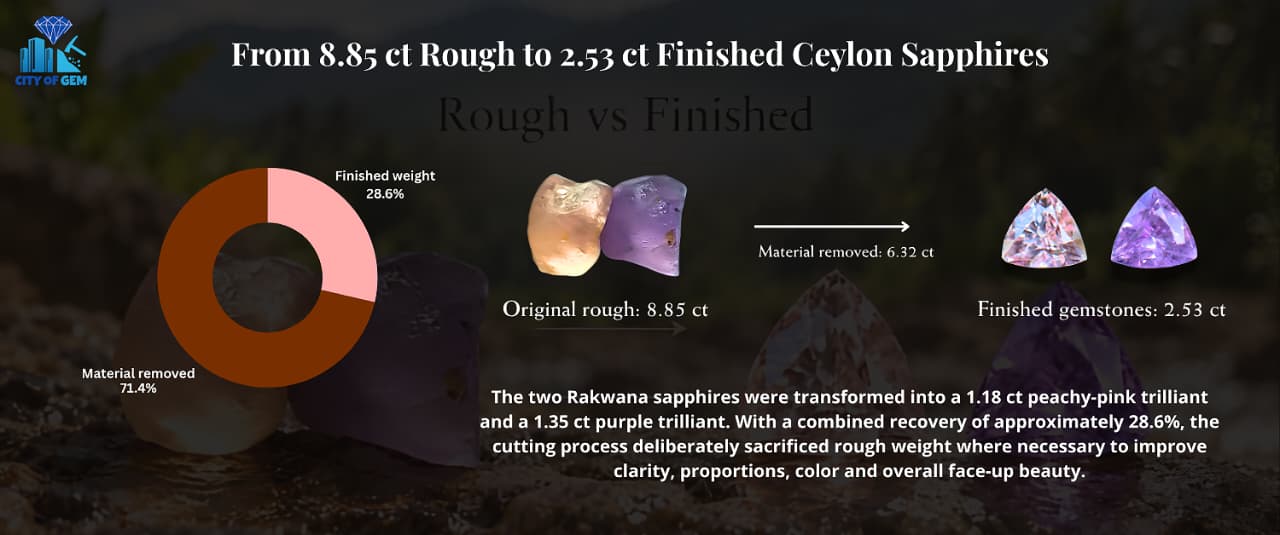
For these two stones, the value of the cutting journey is therefore better understood through the final appearance rather than recovery percentage alone. Material was deliberately removed where necessary to manage internal features, create suitable proportions and reveal better-looking gemstones.
The final result is a beautiful natural sapphire couple with two different but complementary colors: one peachy pink and one purple. Both have been transformed from irregular alluvial rough into elegant trilliant-cut Ceylon sapphires while preserving their individual natural character.
What makes this journey especially meaningful is that our customer was able to experience several stages personally: travelling to a Sri Lankan gem source area, selecting the rough, returning to our office, studying the internal structure and seeing how cutting decisions were made.
At City of Gem, this is the kind of gemstone journey we value. A finished sapphire is not only the result of polishing a piece of rough. Behind it are the source, the natural structure of the crystal, the decisions made during cutting and the people involved along the way.
From the gem-producing area of Rakwana to our cutting process and finally to two finished trilliant sapphires, this pair carries a clear connection to its origin.
The stones are now completed and ready for shipping to Europe
Frequently Asked Questions
The rough sapphires were purchased during a gem hunting journey in the Rakwana gem-producing area of Sri Lanka together with our European customer.
Natural sapphire rough can contain fractures, feathers, inclusions, irregular surfaces and areas unsuitable for the final gemstone. Cutting decisions were made to improve clarity, proportions, durability and face-up color rather than simply retaining maximum weight.
During trimming and preforming, the natural structure and usable areas of both rough stones developed toward triangular outlines. A trilliant design allowed us to work with the material rather than forcing a shape that could have created unnecessary additional loss.
Recovery is the percentage of the original rough weight remaining after cutting. For example, the 4.28 ct peachy-pink rough finished at 1.18 ct, giving approximately 27.6% recovery.
Yes. These are natural Sri Lankan sapphires sourced as rough from the Rakwana area and represented as unheated stones.
Our sourcing approach focuses on direct connections with Sri Lankan gemstone-producing areas, allowing suitable customers to experience more of the journey from rough selection to finished gemstone.