Oct 24, 2026
From Kolonna Rough to a Rare Vanadium Chrysoberyl: A Sri Lankan Gemstone Sourcing and Cutting Journey
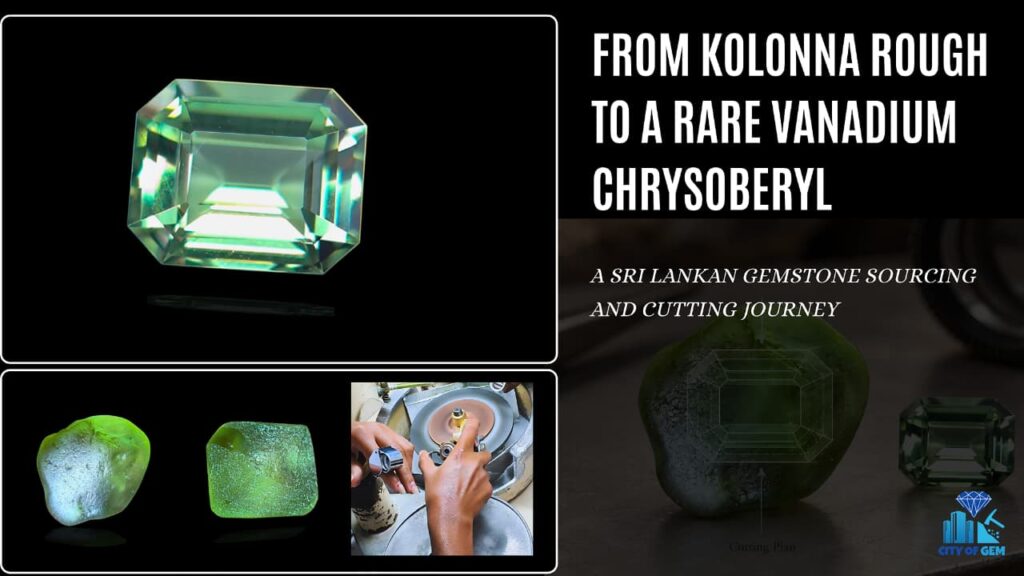
Some gemstones attract attention because of size or intense color. Others become important because they challenge the first impression and reveal something much more unusual after careful observation. This 1.45 ct natural facet-grade rough from Kolonna, Sri Lanka, became one of those memorable stones for City of Gem.
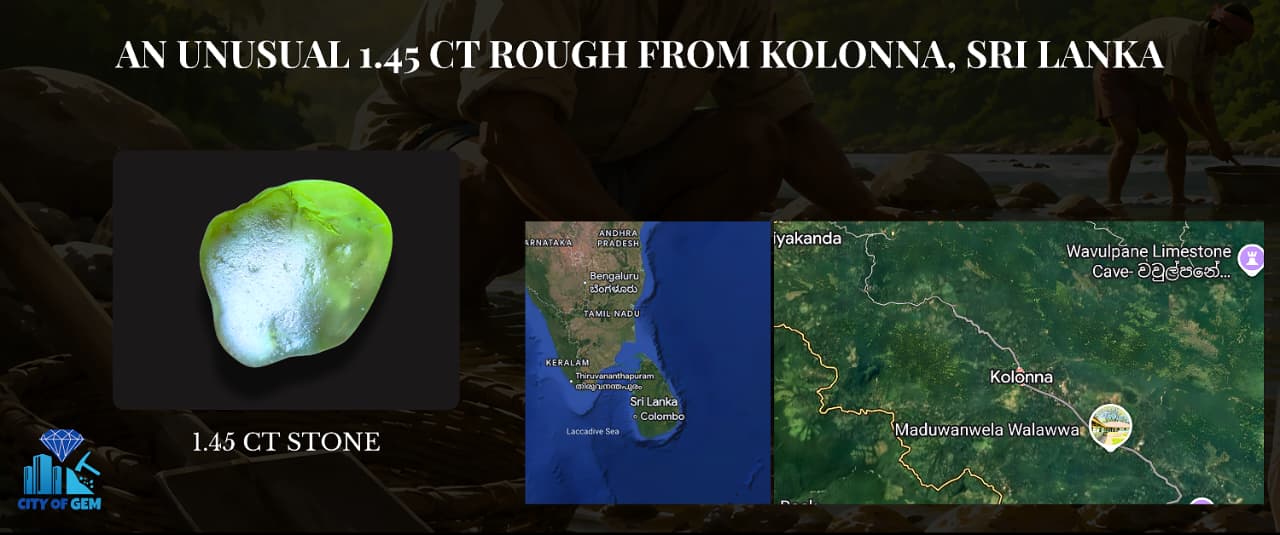
The rough was sourced from Kolonna village around mining in Sri Lanka’s Sabaragamuwa Province. Kolonna has a long-standing reputation among people involved in the Sri Lankan gemstone trade for producing unusually varied gem materials. There is even an old informal saying heard among local traders: “What stone is not found in Kolonna?” It should be understood as gemstone-market folklore rather than a scientific geological statement, but it reflects the remarkable variety associated with the area.
Kolonna is not necessarily known for producing large quantities of every gemstone variety. Some discoveries may be small, isolated or commercially modest. What makes the area interesting is the possibility of encountering unusual minerals, colors and gem varieties among its alluvial material. That unpredictability is one reason source-area buying remains so fascinating.
This particular rough came from an area slightly south of Kolonna’s higher mountain terrain. Its rounded, naturally worn surface clearly suggested an alluvial history. At only 1.45 ct, it was not a large stone, but its transparency, cleanliness and unusual green appearance immediately gave it excellent faceting potential.
An Unusual Green Chrysoberyl at First Sight
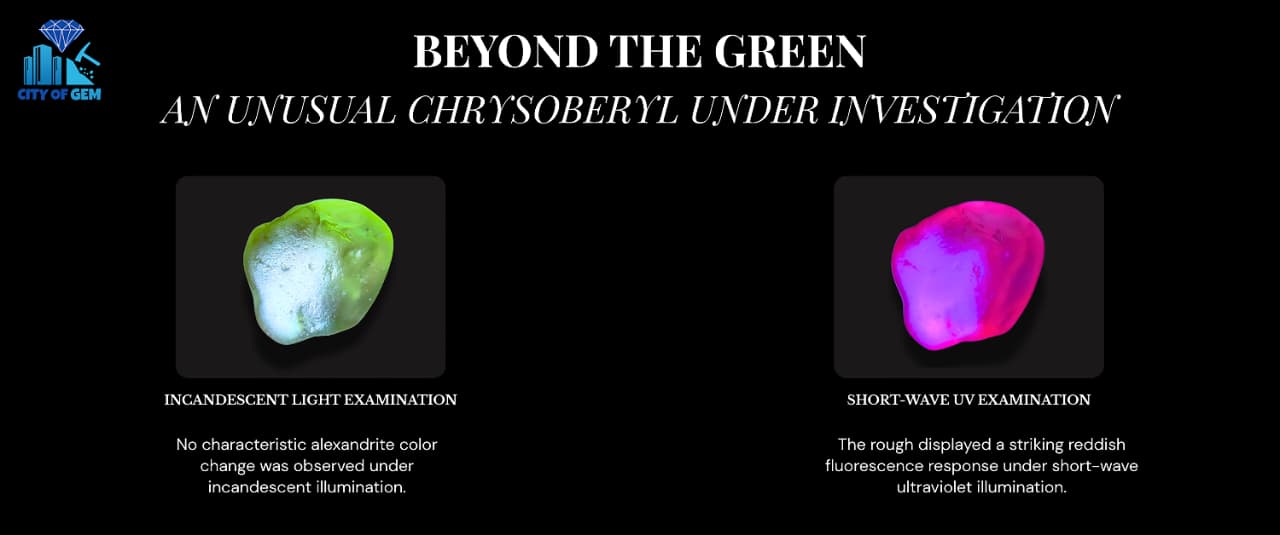
Under normal observation, the rough displayed an attractive fresh green color that did not immediately resemble the more familiar yellowish-green chrysoberyl commonly encountered in the Sri Lankan gem market.
The first surprise came during ultraviolet observation. Under the short-wave UV source used during our examination, the rough showed a striking reddish response. Because chromium-bearing alexandrite can show reddish fluorescence and, more importantly, a green-to-red or purplish-red color change between different lighting environments, our first thought was naturally to investigate whether the stone could belong to the alexandrite variety.
We therefore examined the rough under different lighting conditions, including incandescent illumination. Despite its unusual green appearance and UV reaction, we did not observe the characteristic alexandrite color change under incandescent light.
That distinction is important. UV fluorescence alone does not identify alexandrite. The defining visual feature of alexandrite is its color change between daylight-type and incandescent illumination. GIA describes alexandrite as the chromium-bearing color-change variety of chrysoberyl, typically appearing bluish green in daylight and purplish red under incandescent illumination.
The absence of that characteristic color change shifted our attention toward another rare possibility: vanadium chrysoberyl.
What Is Vanadium Chrysoberyl?
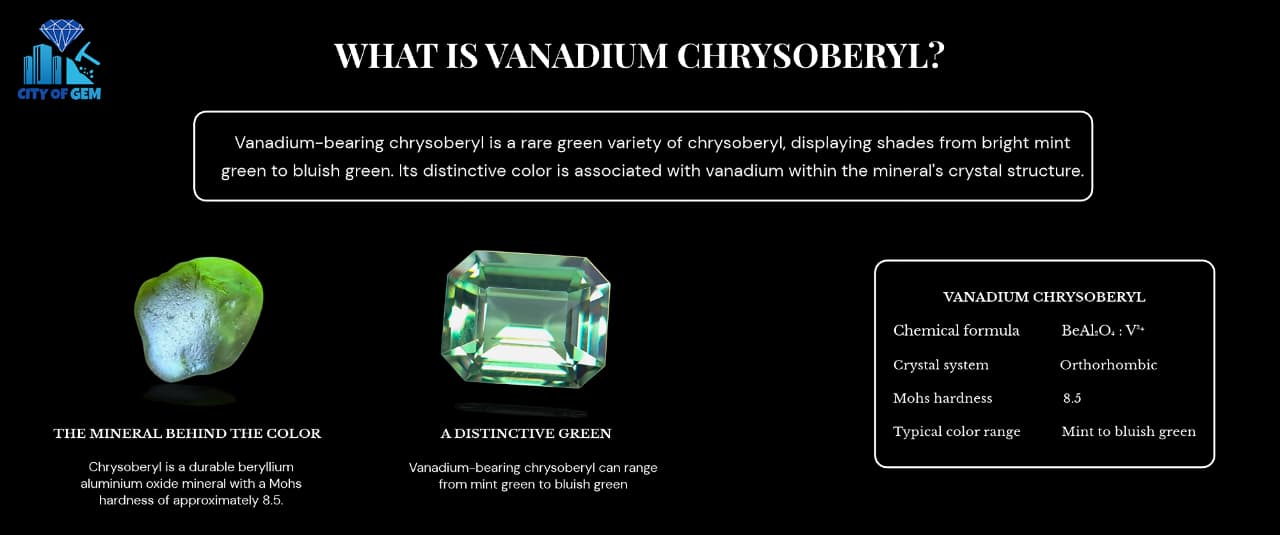
Chrysoberyl is a beryllium aluminium oxide with the chemical formula BeAl₂O₄ and an orthorhombic crystal structure. Standard gemological properties include a refractive index around 1.746–1.755, specific gravity near 3.7, and a Mohs hardness of approximately 8.5, making chrysoberyl a durable gemstone suitable for jewellery when properly cut and set.
Most ordinary yellow to yellowish-green chrysoberyl owes much of its color to iron. Vanadium-bearing chrysoberyl is different. Research published by the Swiss Gemmological Institute SSEF describes vanadium chrysoberyl as ranging from bright mint green to saturated bluish green, with documented natural occurrences including Sri Lanka, Tanzania, Madagascar and Myanmar.
GIA has similarly documented natural green chrysoberyl whose color is associated with V³⁺ substituting for Al³⁺ in the chrysoberyl crystal lattice. Importantly, this material may show an attractive green appearance without the green-to-red color change that defines alexandrite.
There is also an important gemological caution. A yellowish-green chrysoberyl containing only traces of vanadium should not automatically be called vanadium chrysoberyl. SSEF explains that meaningful classification considers the visual color together with absorption spectroscopy and chemical trace-element analysis, especially because iron, chromium and vanadium can occur together and influence the final appearance.
For this Kolonna stone, the final identification was vanadium chrysoberyl, making the small green rough considerably more interesting than its size might initially suggest.
Planning the Cut From a 1.45 ct Alluvial Rough
Once the gemological character of the material had become clear, the next stage was to decide how to release the best possible appearance from the rough.
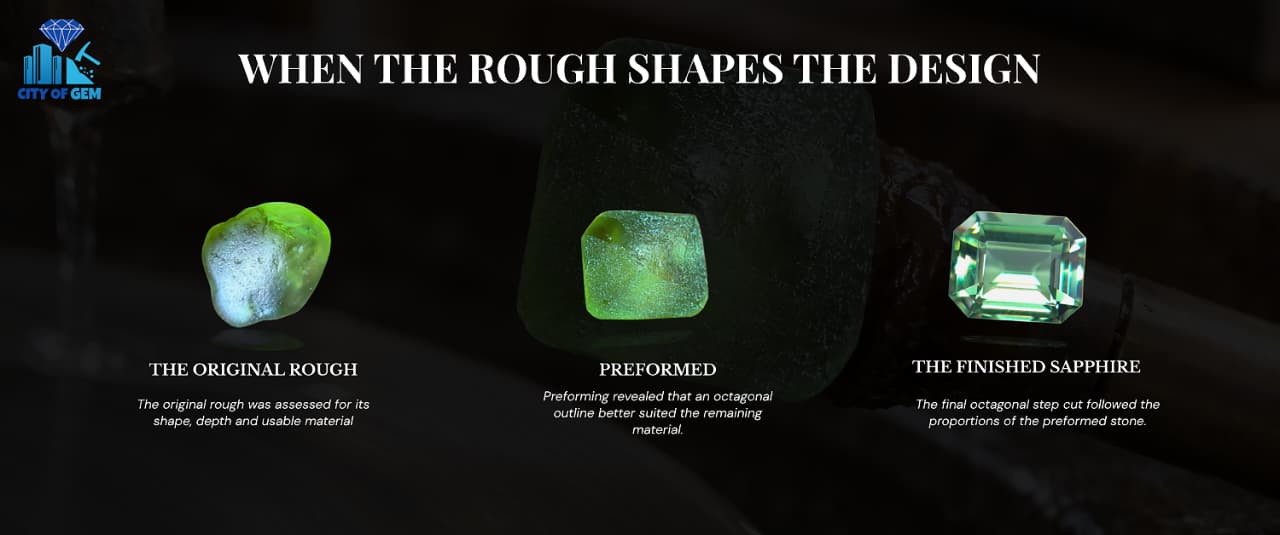
City of Gem sourced and preformed the stone. During the early planning stage, our first idea was a cushion-style cut, because the original alluvial shape appeared capable of supporting that outline.
However, gemstone cutting must follow the actual usable material rather than the first design idea.
After carefully preforming the rough and removing areas that would not contribute positively to the finished gemstone, its proportions began to suggest a different solution. The remaining material naturally suited an octagonal step-style shape much better.
Rather than forcing the stone into the originally imagined cushion and sacrificing additional material or compromising its proportions, we changed the cutting plan.
This is an important part of genuine custom gemstone cutting: the best design often becomes clear only after the cutter can properly understand the internal structure, depth, color orientation and usable geometry of the rough.
The final faceting was completed by our expert cutter, Mr. Praveen.
From 1.45 ct Rough to 0.50 ct Finished
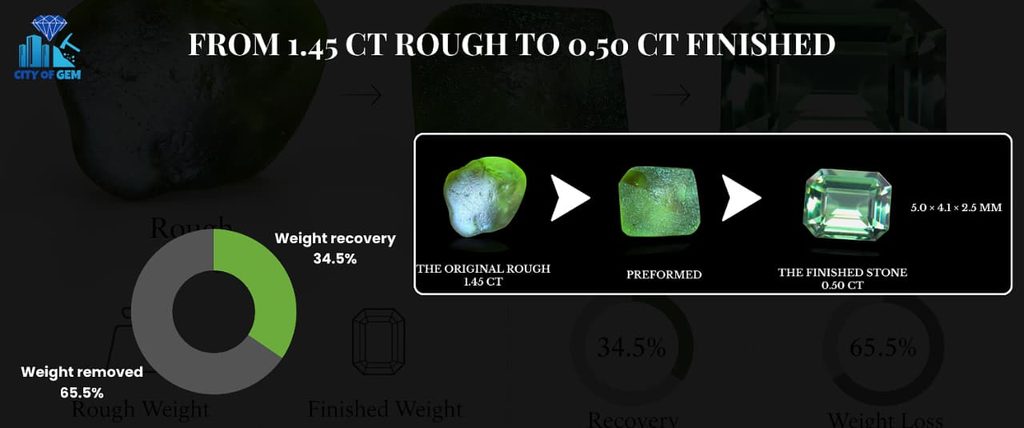
The original natural rough weighed:
1.45 ct
After preforming, faceting and polishing, the finished vanadium chrysoberyl weighed:
0.50 ct
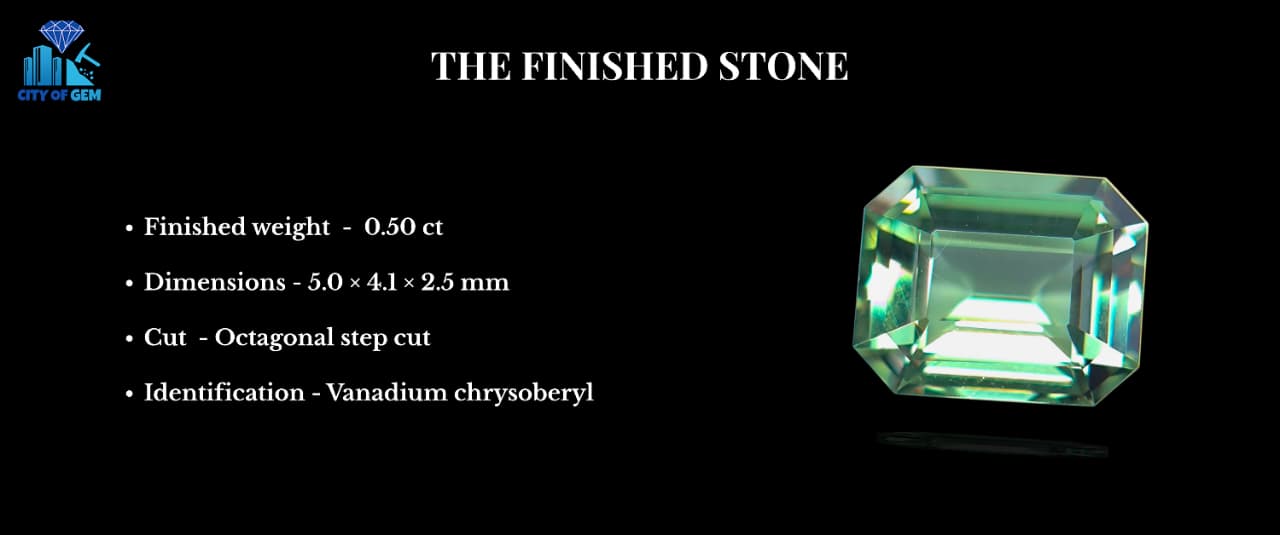
The final measurements are approximately:
5.0 × 4.1 × 2.5 mm
The finished-weight recovery is approximately 34.5%, meaning about 65.5% of the original rough weight was removed during the complete cutting process.
For small natural rough gemstones, recovery percentage must always be interpreted together with the original geometry. Weight may be lost while removing weathered surface material, improving proportions, creating the girdle, establishing the pavilion and crown, and positioning the stone for better light performance.
The objective was therefore not maximum carat retention. It was to produce a proportionate, attractive gemstone that showed the unusual green body color and lively optical character of the material.
The final result exceeded what the modest 1.45 ct alluvial pebble initially suggested. At 0.50 ct, the finished octagonal vanadium chrysoberyl displays excellent brightness, a clean appearance and a fresh green to slightly bluish-green impression under suitable lighting.
After cutting, we carried out advanced gemological testing on the finished stone. Based on those test results, the gemstone was confirmed as vanadium chrysoberyl.
Why This Kolonna Stone Matters
Vanadium chrysoberyl is considerably less familiar to the general market than yellow chrysoberyl, cat’s-eye chrysoberyl or alexandrite. SSEF describes attractive vanadium-colored material as comparatively rare and notes that fine examples are of interest to gemstone collectors and jewellery designers.
This stone is therefore interesting on several levels: its Sri Lankan origin, its alluvial surface, its unusual initial green appearance, its UV reaction, the need to distinguish it from alexandrite, and finally the transformation from a small rough pebble into a precisely faceted collectible gemstone.
For City of Gem, this is exactly why direct gemstone sourcing matters. When working close to Sri Lankan source areas, the most interesting discoveries are not always large commercial sapphires. Sometimes a 1.45 ct green pebble from Kolonna can become a rare 0.50 ct vanadium chrysoberyl with an entire gemological story behind it.
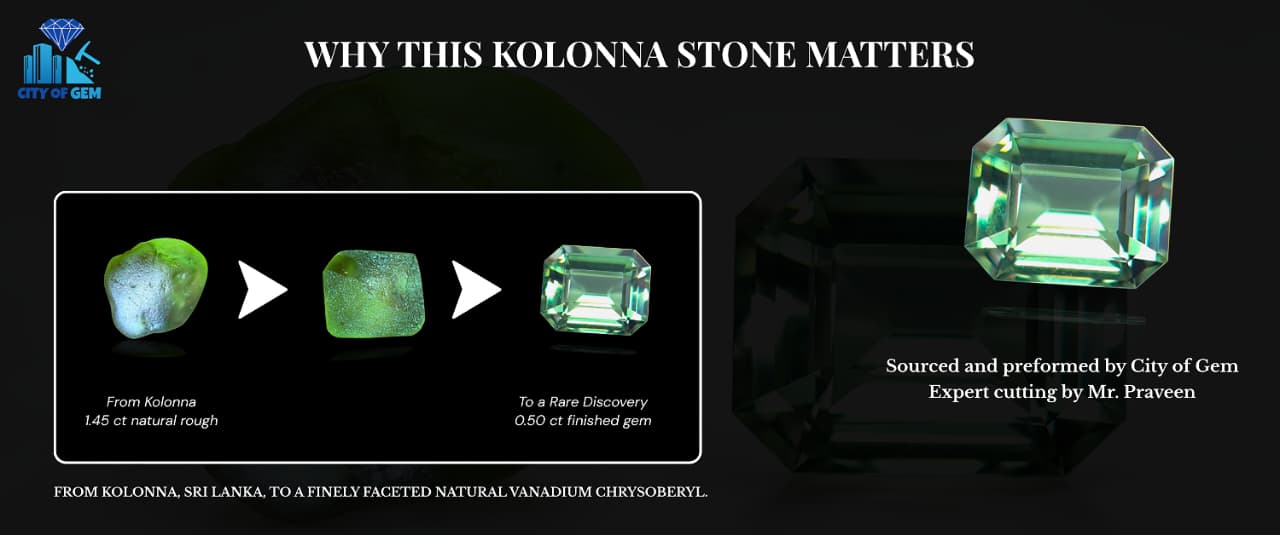
Sourced and preformed by City of Gem.
Expert cutting by Mr. Praveen.
From Kolonna village around mining in Sri Lanka to a finished natural vanadium chrysoberyl.
Sources:
Sources 01 – https://www.ssef.ch/de/v-chrysoberyl/?utm
Sources 02 –https://origin.prod.author.gia.edu/alexandrite?utm
Sources 03 – https://www.gia.edu/gems-gemology/spring-2014-v-chrysoberyl-stone-sundberg?utm
Frequently Asked Questions
1. What is vanadium chrysoberyl?
Vanadium chrysoberyl is a green variety of chrysoberyl in which vanadium contributes importantly to the gemstone’s color. Fine material may show mint-green to bluish-green hues.
2. Is vanadium chrysoberyl the same as alexandrite?
No. Alexandrite is the color-change variety of chrysoberyl and is principally associated with chromium. Vanadium chrysoberyl may be green but show little or no alexandrite-type green-to-red color change.
3. Can vanadium chrysoberyl come from Sri Lanka?
Yes. Sri Lanka is among the documented natural sources of vanadium-bearing chrysoberyl.
4. Does red fluorescence under UV prove a stone is alexandrite?
No. Fluorescence is only one observation. Alexandrite identification depends importantly on its characteristic color-change behavior together with appropriate gemological testing.
5. What was the cutting recovery of this stone?
The rough weighed 1.45 ct and the finished gemstone weighs 0.50 ct, giving approximately 34.5% recovery and 65.5% weight removal.
6. What is the finished shape and size?
The finished gemstone is an octagonal step-style cut, measuring approximately 5.0 × 4.1 × 2.5 mm.
7. Who completed the cutting?
The stone was sourced and preformed by City of Gem, with the final precision cutting completed by expert cutter Mr. Praveen.