
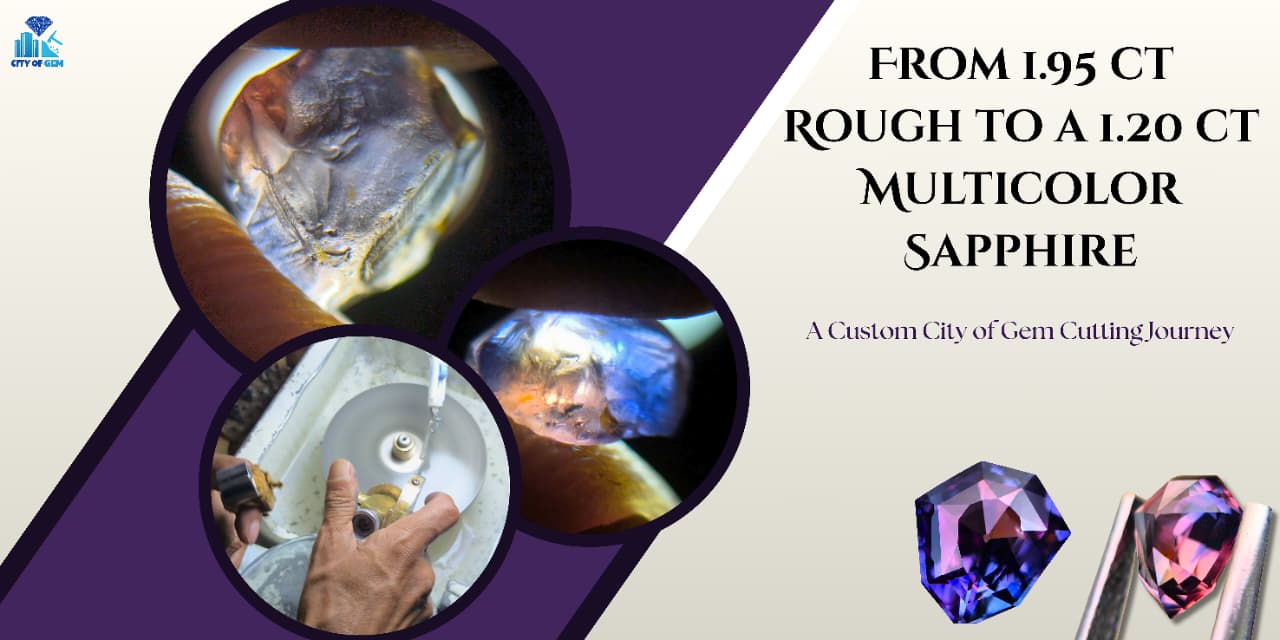
Some gemstones are straightforward to cut. Others require much more than simply choosing an oval, cushion, or round shape and following a standard cutting pattern.
This natural unheated multicolor sapphire was one of those stones.
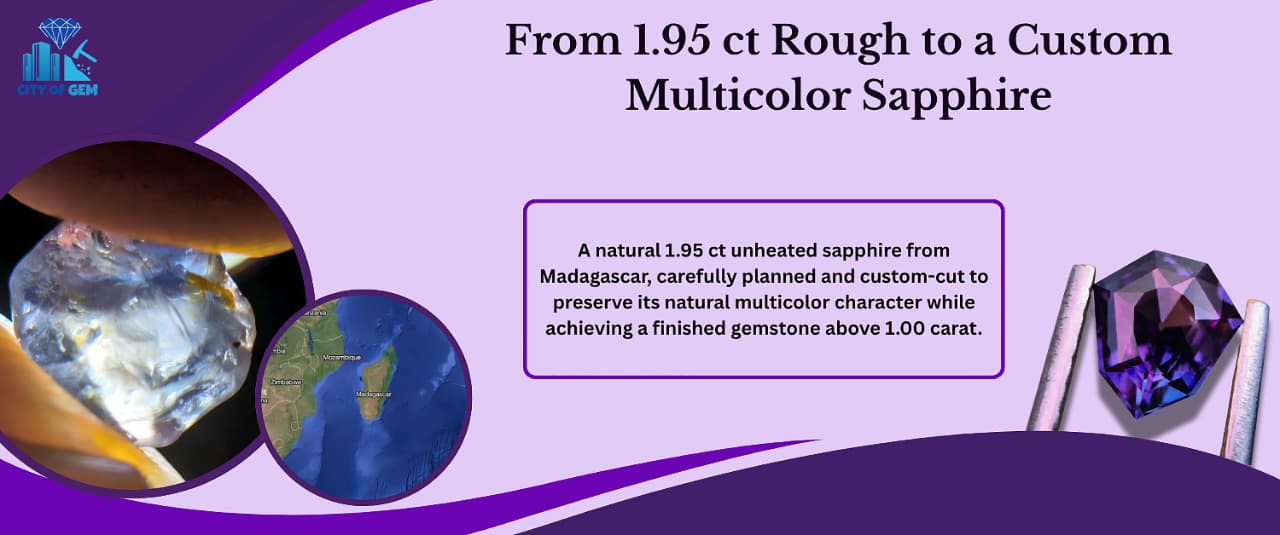
The journey began with a 1.95 ct rough sapphire from Madagascar, sourced by City of Gem in its natural rough form. A customer from Germany purchased the stone as rough and requested a very specific custom cutting result.
The challenge was not only to create a beautiful finished gemstone. The customer had two important requirements: the finished sapphire should remain above 1.00 carat, and the cutting should reveal as many of the natural colors as realistically possible.
That combination made the planning process especially important.
A Rough Sapphire With Several Colors in One Stone
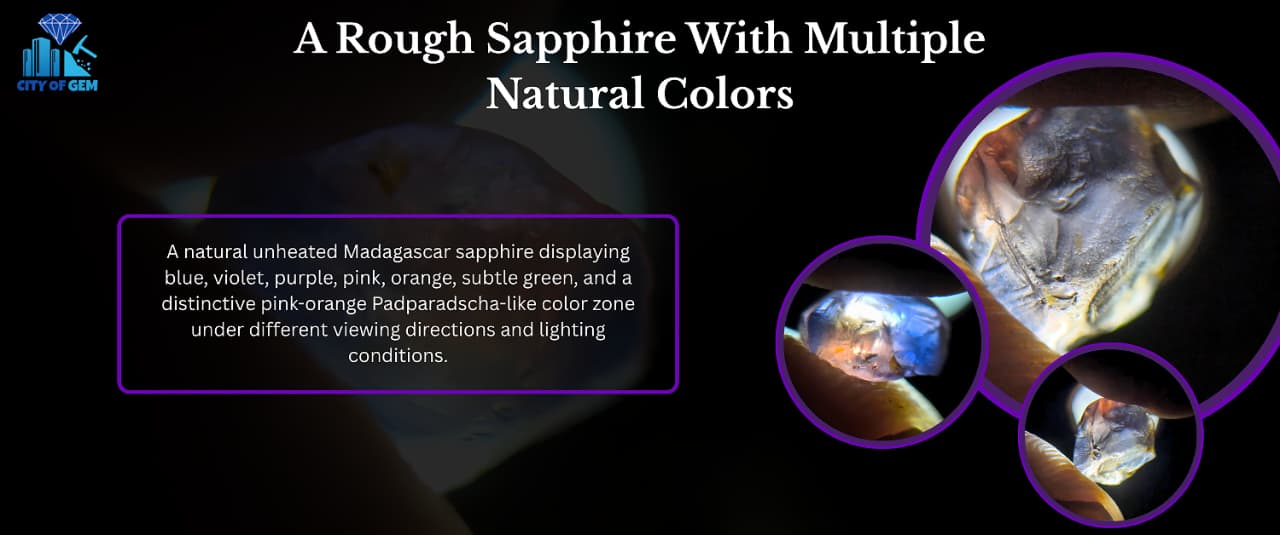
Under different viewing directions and lighting conditions, the rough showed a remarkable combination of color.
Different areas revealed tones of blue, violet, purple, pink, orange, a subtle greenish hue, and a pink-orange Padparadscha-like hue.
This does not mean the entire gemstone should be classified as Padparadscha sapphire. Rather, one portion of the rough displayed an attractive pink-orange color reminiscent of the Padparadscha color range.
The difficulty was that this pink-orange area was not positioned in the most practical direction for creating the main face of the finished gemstone.
This is where cutting becomes more than simply shaping a rough stone.
Why Gemstone Orientation Matters
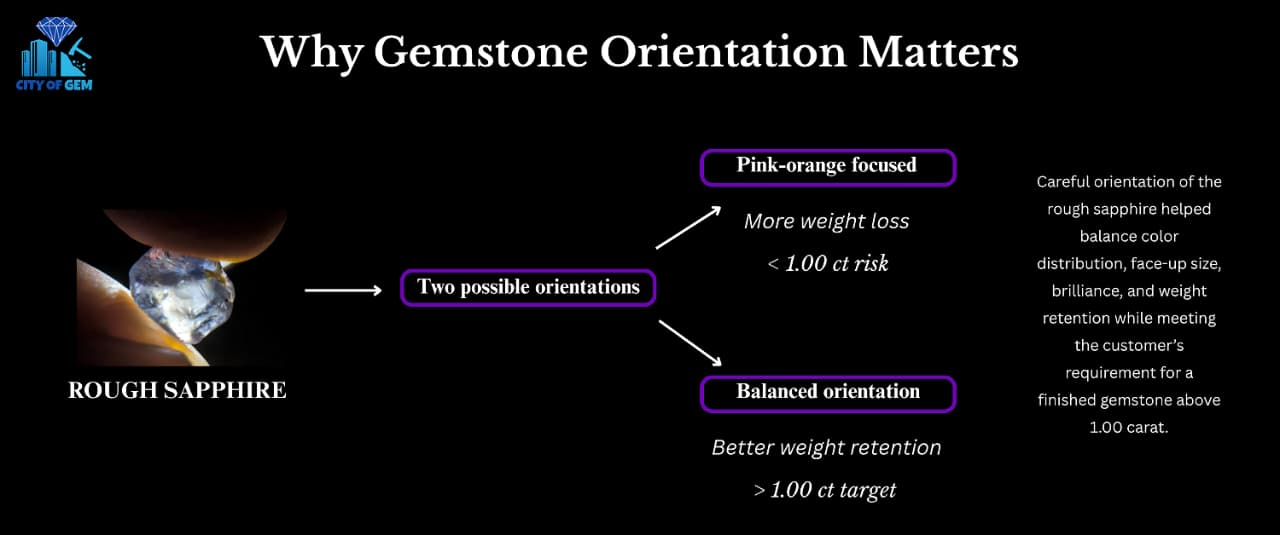
Before a sapphire is cut, the cutter must study the rough from different directions.
The apparent color of sapphire can change significantly depending on orientation, especially when the rough contains color zoning or multiple hues.
In this stone, orienting the main face directly toward the strongest pink-orange area would have required removing too much material. Based on the shape and dimensions of the rough, keeping more than one carat after cutting would have become extremely difficult.
The customer had specifically requested a finished weight above 1.00 ct, so sacrificing excessive weight purely to face one color was not the best solution.
Instead, City of Gem discussed the rough with the cutter and the customer to find a practical balance between weight retention, face-up size, color distribution, brilliance, and overall design.
Why a Standard Oval or Cushion Was Not the Best Choice
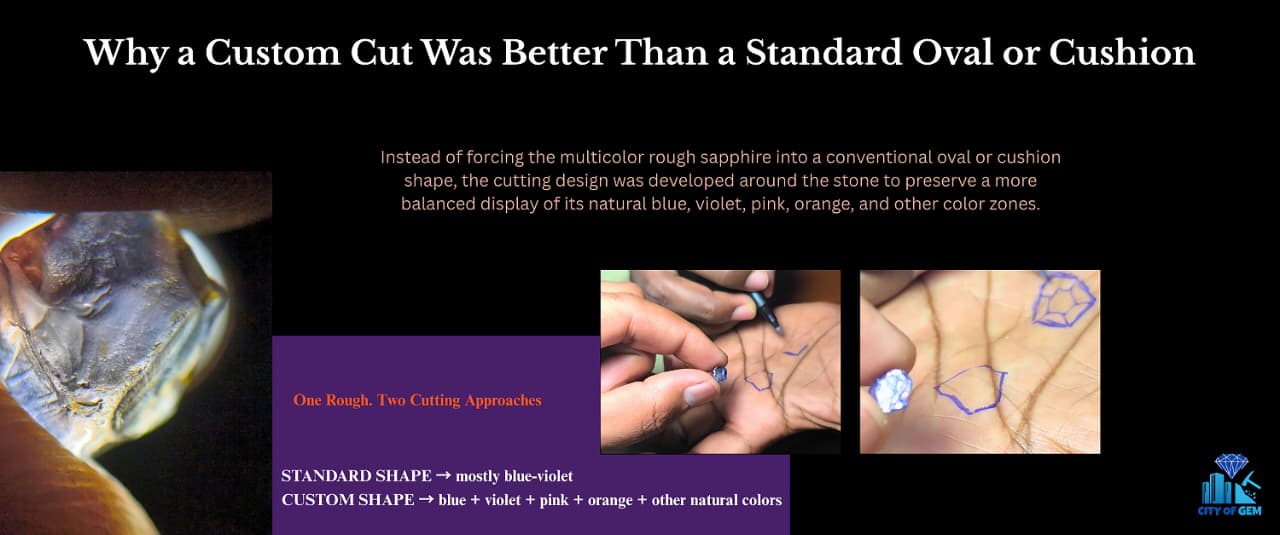
A conventional oval or cushion shape might initially seem like the easiest option.
However, in a multicolor sapphire, a standard design can sometimes cause one dominant color direction to control most of the face-up appearance.
In this rough, the blue-violet direction naturally faced more strongly toward the potential table orientation.
If the stone had simply been cut as a normal cushion or oval, much of the subtle pink, orange, violet, and other color areas could have become less visible from the face.
The goal was therefore not to force the rough into a familiar shape.
The goal was to create a shape around the stone.
That is an important difference in custom gemstone cutting.
Designing a Unique Shield-Style Cut
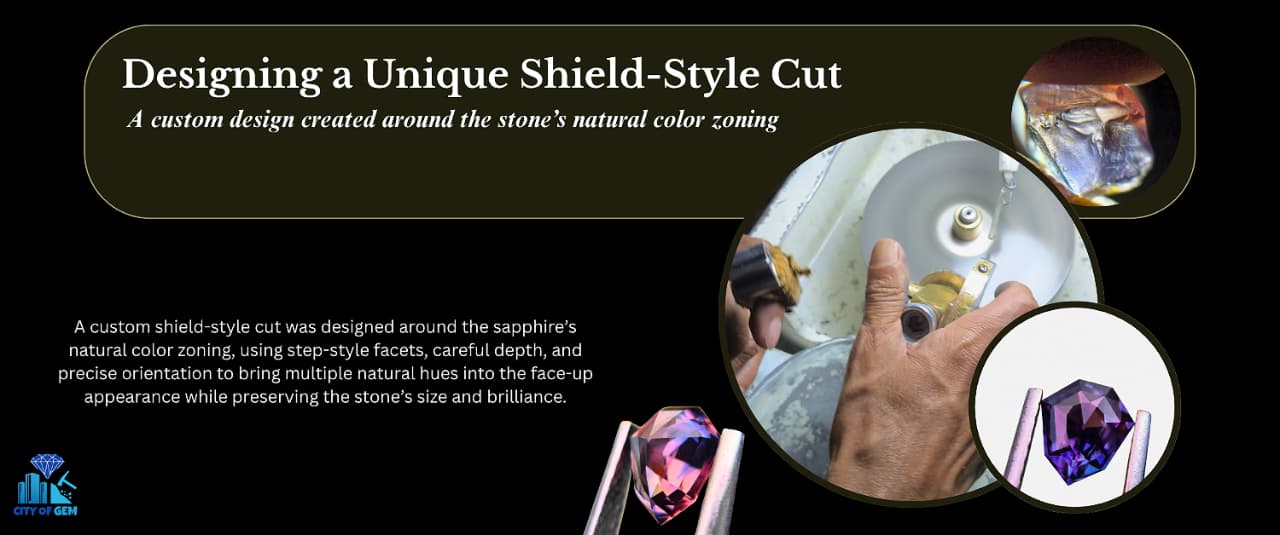
After studying the rough and discussing the possibilities, a custom shield-style shape was selected.
The design was developed to preserve a broad face while maintaining sufficient depth and allowing light to interact with different color zones.
Step-style facets were incorporated into the cutting concept so that different sections of the sapphire could contribute to the final face-up appearance.
Rather than allowing only one color zone to dominate, the design aimed to bring several natural hues into view as the gemstone moves.
This type of work requires careful compromise.
A cutter cannot independently control every color inside a natural sapphire. The internal zoning already exists in the rough. Cutting can only work with that natural structure through orientation, facet placement, depth, angles, and shape.
The result therefore depends on both the gemstone and the decisions made during planning.
From 1.95 ct Rough to 1.20 ct Finished Sapphire
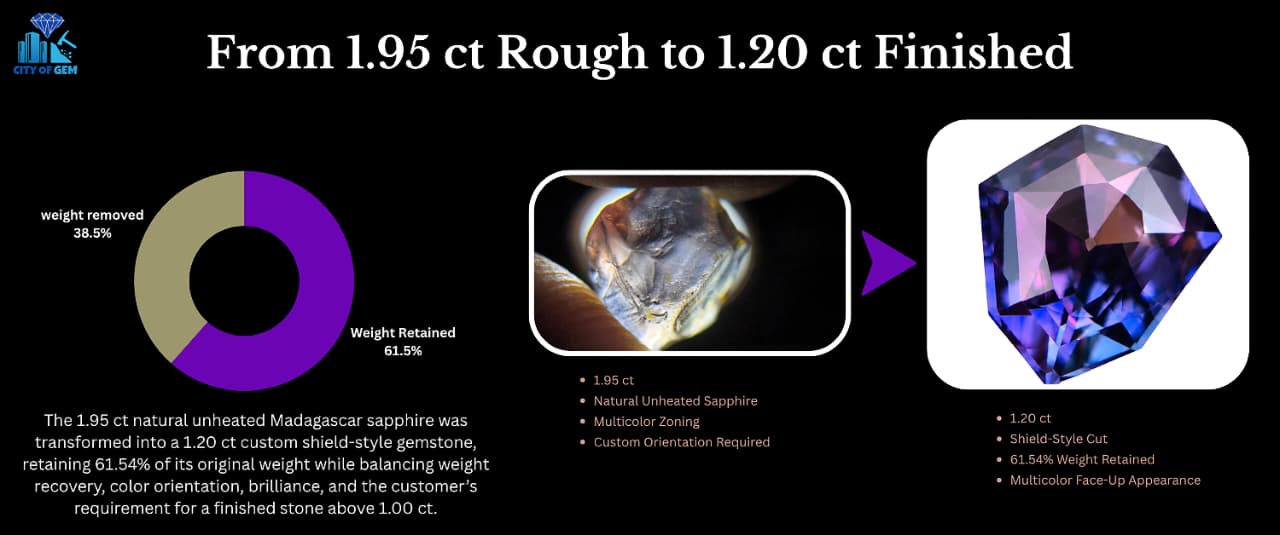
This means approximately 61.54% of the original rough weight was successfully retained, while 38.46% was removed during preforming, shaping, faceting, and polishing.
For this particular sapphire, the recovery percentage is especially meaningful because the objective was not simply to maximize carat weight.
The German customer specifically requested a finished stone above 1.00 ct, while also wanting as many of the rough sapphire’s natural colors as possible to contribute to the face-up appearance.
The finished 1.20 ct result exceeded the requested minimum weight by 0.20 ct, while the custom shield-style orientation helped preserve the unusual multicolor character of the original rough.
This is a good example of why cutting percentage should never be judged by weight alone.
A successful cutting result is a balance between weight recovery, color orientation, face-up dimensions, brilliance, clarity, durability, and the customer’s individual requirements.
The final result successfully remained well above the customer’s minimum one-carat requirement.
But weight retention alone was not the purpose of this project.
The real objective was to retain enough weight while creating a gemstone that expressed the unusual color character hidden inside the rough.
A Different Appearance From Different Angles
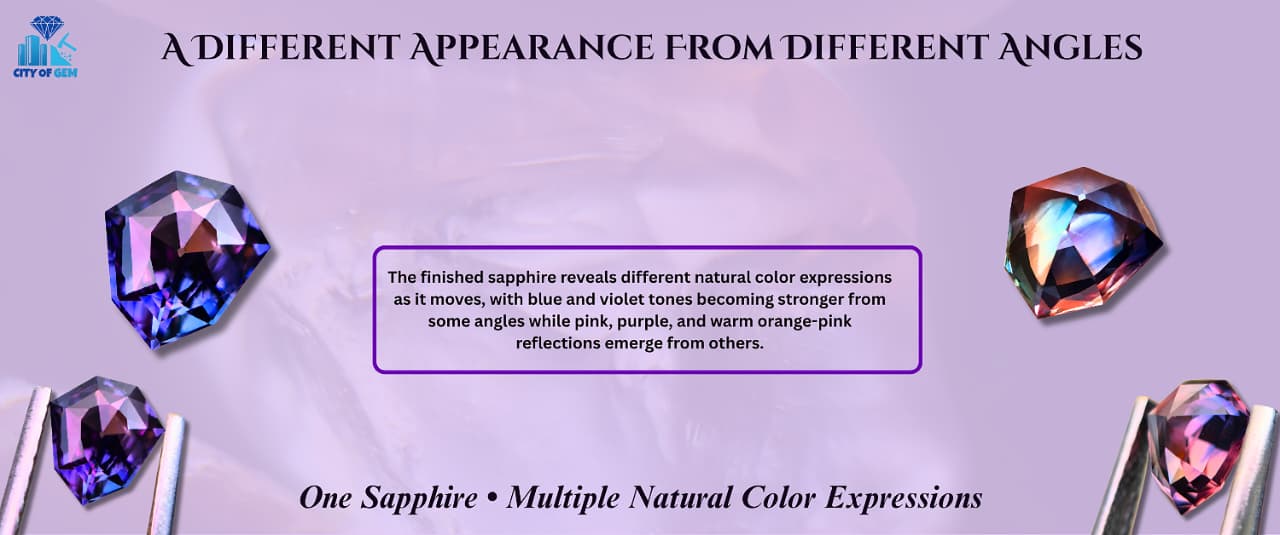
The finished sapphire does not show exactly the same color from every position.
That is part of its character.
In some views, stronger blue and violet tones appear. In others, pink, purple, and warmer orange-pink reflections become more noticeable.
Small shifts in angle and lighting can change the visual balance of the stone because the original rough contained several differently oriented color areas.
This makes the finished gemstone much more interesting than a sapphire cut simply to produce one uniform face-up color.
It is a gemstone that needs to be viewed in movement.
Why Custom Cutting Matters
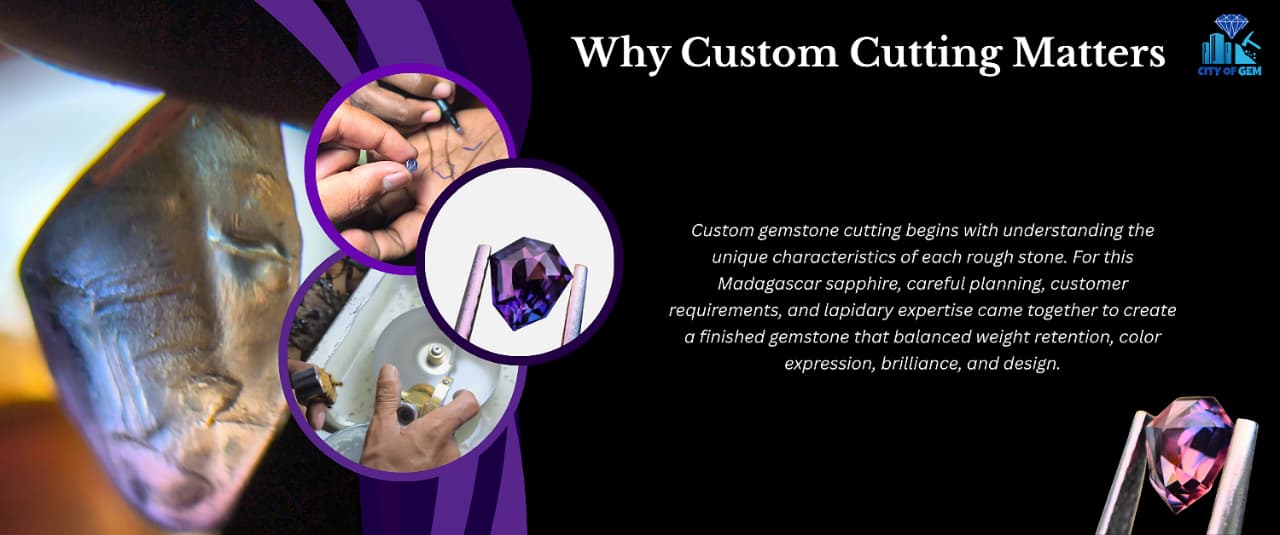
A rough gemstone has limits.
Every rough stone has its own shape, depth, internal features, fractures, color zoning, transparency, and directional color.
A professional cutting plan therefore should not begin with the question:
“What standard shape should we cut?”
A better question is:
“What can this particular rough become?”
For this Madagascar sapphire, the answer was not a standard oval or cushion.
The rough demanded a more individual solution.
The customer’s request also influenced every decision. The finished weight needed to remain above one carat, while the multicolor appearance needed to be preserved as much as possible.
That is why communication between the gemstone owner, the supplier, and the lapidary is so important.
How City of Gem Handles Custom Rough-to-Finished Projects
City of Gem works with gemstones from the sourcing stage through planning, cutting, polishing, certification support, and final presentation.
For custom cutting projects, we first study the rough realistically.
We consider its weight, dimensions, transparency, inclusions, fractures, color distribution, possible orientation, expected weight loss, and suitable cutting styles.
When a customer has a particular requirement, such as a minimum finished weight, preferred shape, jewelry dimensions, pair matching, or preservation of a specific color zone, that requirement becomes part of the cutting plan.
However, natural gemstones cannot always deliver every requested feature simultaneously.
Sometimes maximizing color means losing more weight. Sometimes retaining weight means accepting an unconventional outline. Sometimes a standard shape hides the most interesting part of the gemstone.
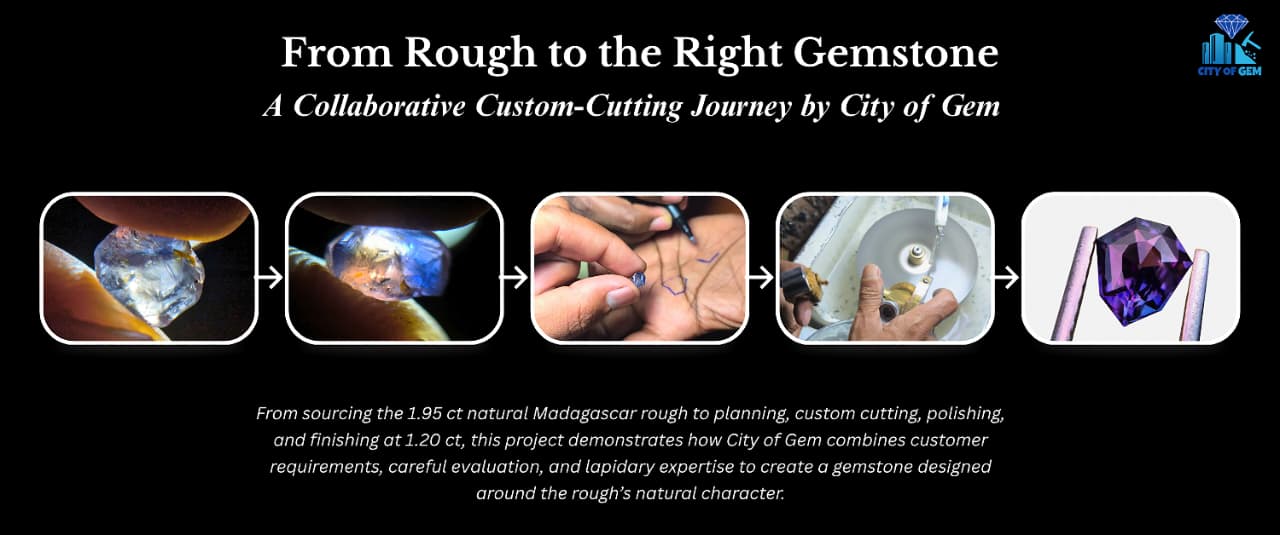
The purpose of professional cutting is therefore to find the best realistic balance.
This 1.95 ct Madagascar multicolor sapphire is a good example.
The rough did not need to become a standard gemstone.
It needed to become the right gemstone for its own natural structure.
The final 1.20 ct shield-style sapphire now carries multiple visible hues, an individual face-up character, and a cutting design created around the original rough rather than imposed upon it.
From source rough to finished gemstone, this is the kind of practical, collaborative gemstone journey City of Gem aims to provide.
Frequently Asked Questions
The gemstone is best described as a multicolor sapphire. Part of the rough showed an attractive pink-orange or Padparadscha-like hue, but the finished gemstone contains several colors, including blue, violet, purple, pink and warmer orange-pink areas. Calling the entire stone Padparadscha based only on one color zone would not accurately describe its overall appearance.
A standard oval or cushion could have caused the dominant blue-violet orientation to control more of the face-up appearance. The custom shield-style design provided more flexibility for preserving weight and presenting several of the natural color zones.
The pink-orange direction was not positioned favorably relative to the rough's shape and available depth. Orienting the entire gemstone toward that color would likely have required substantially greater weight loss and made the customer's minimum one-carat requirement difficult to achieve.
The rough weighed 1.95 ct, and the finished sapphire weighs 1.20 ct, giving a weight recovery of approximately 61.5%.
Material must be removed to eliminate unsuitable outer surfaces, establish symmetry, create pavilion and crown angles, polish facets, and produce the final outline. The amount of loss depends heavily on the original shape and condition of each rough stone.
No. It is a natural unheated multicolor sapphire.
The rough sapphire originated from Madagascar.
The finished gemstone measures approximately 7.2 × 6.5 × 3.5 mm and weighs 1.20 ct.
Yes. City of Gem can work with custom requests involving preferred shapes, minimum weight targets, jewelry dimensions, pairs, unusual cutting designs, and color-orientation goals. Each rough gemstone must first be evaluated because natural material has its own limitations.
Not necessarily. Cutting can improve how different color zones interact with the face of a gemstone, but the location and orientation of those colors are naturally determined inside the rough. The cutter's role is to find the most effective realistic orientation and design rather than promise that every internal color will appear equally.