
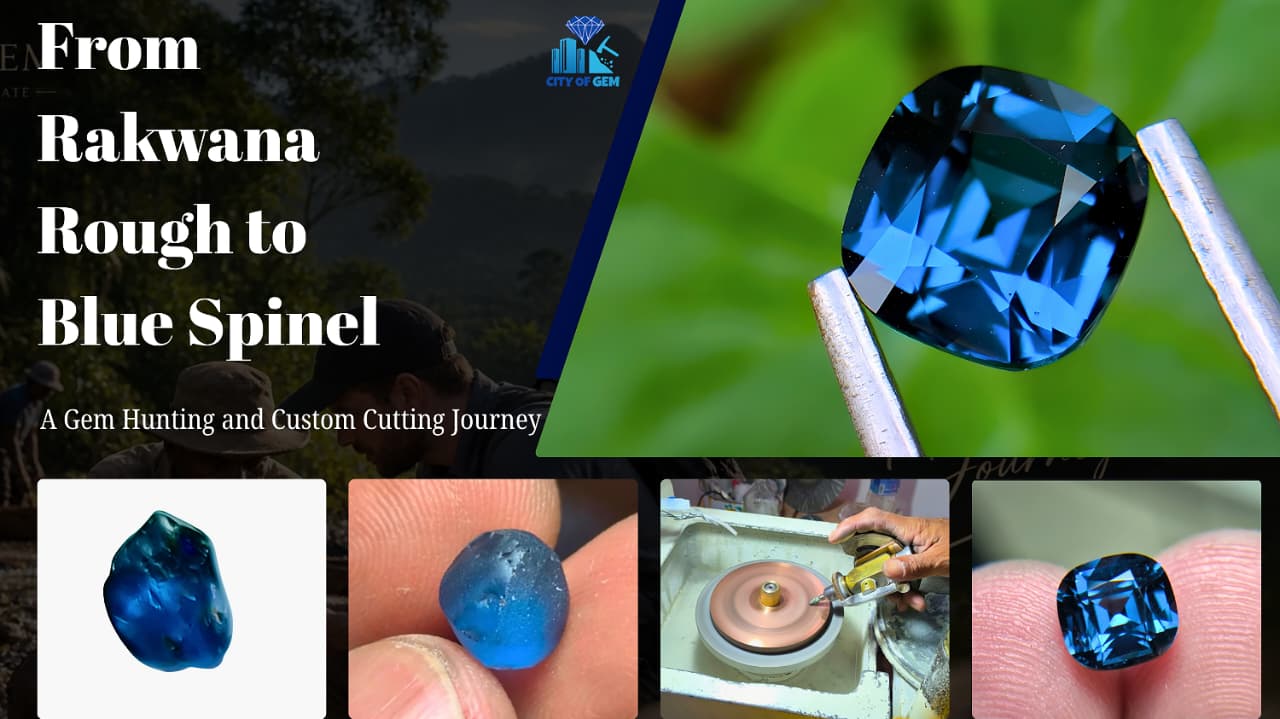
Some gemstone journeys begin in a showroom. This one began much closer to the source. During a City of Gem gem-hunting journey with one of our European customers, we travelled through the gemstone-producing areas around Rakwana, Sabaragamuwa Province, Sri Lanka, near the Sinharaja rainforest region. The purpose was not simply to purchase gemstones, but to give our customer a closer experience of how Sri Lankan gemstones move from source areas into the hands of buyers, cutters and collectors. During this journey, we sourced a 5.74 ct natural blue spinel rough, which later became a beautifully finished 1.65 ct gemstone.
Gem Hunting Around Rakwana, Sri Lanka
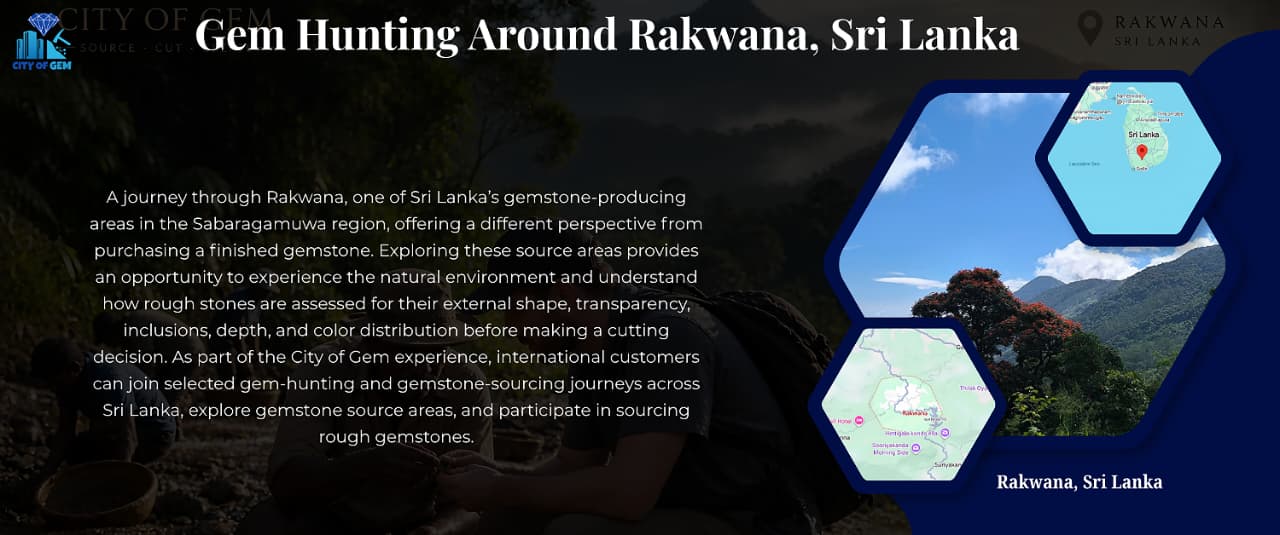
Rakwana is one of the gemstone-producing areas of Sri Lanka’s Sabaragamuwa region. Travelling through these source areas gives a very different perspective from purchasing an already-finished gemstone. Rough stones do not immediately reveal exactly what they will become. Their external shape, transparency, inclusions, depth and color distribution all need to be considered before a realistic cutting decision can be made.
This is also part of the experience City of Gem offers to international customers. We travel through gemstone source areas across Sri Lanka, and customers from around the world can join us on selected gem-hunting and gemstone-sourcing journeys. Instead of experiencing the Sri Lankan gemstone trade only through finished stones, customers can travel with us, experience the source environment and participate in sourcing rough gemstones. Every journey and every available stone is different, which is exactly what makes real gemstone hunting interesting.
Evaluating the 5.74 ct Blue Spinel Rough
After sourcing the 5.74 ct spinel, we returned to our office for a more careful examination. Finding a promising rough stone is only the beginning. Before cutting, the material needs to be studied from different directions to understand the possible face-up orientation, depth, color concentration and internal features.
The rough contained areas that needed to be removed during preparation. We marked the sections carefully and began trimming and grinding gradually rather than immediately committing the stone to a final shape. This stage is important because every fraction of a carat removed changes the possibilities available to the cutter.
As the unwanted areas were ground away, a cleaner cutting area began to emerge. The developing preform was relatively close to a rounded outline while also offering the possibility of a cushion-style design. At this point, the decision was no longer simply about which shape could retain the greatest amount of weight. Color behavior became an important part of the cutting plan.
Round or Cushion? Choosing the Direction for Better Color
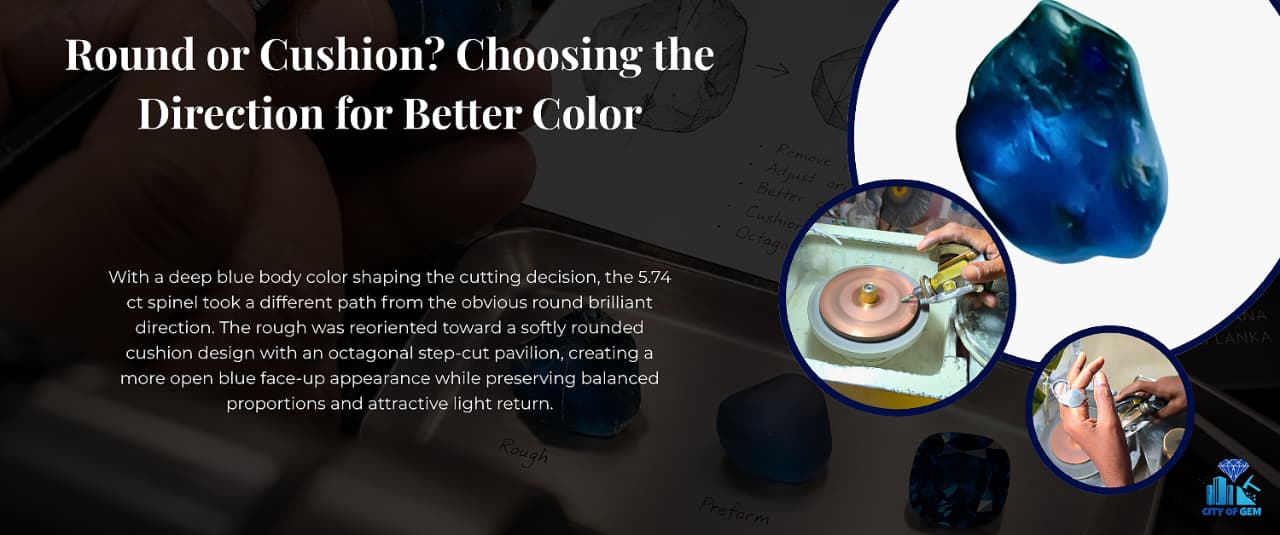
A round brilliant-style stone was one possibility. Round cutting can create strong brilliance when the proportions and material work well together. However, this particular spinel carried a relatively deep blue body color. Following the round direction we were considering could have produced an attractive brilliant stone, but our concern was that the finished face-up appearance could remain darker than desired.
We therefore reconsidered the orientation.
Instead of choosing the shape only for brilliance or maximum weight, we decided to work toward a cushion-style outline with softly rounded corners. The objective was to produce a more open blue face-up appearance while still retaining attractive light return and a balanced shape.
For the pavilion, an octagonal step-cut style was incorporated into the design. This gave the cutter another way to work with the depth and color of the material rather than forcing the rough into a conventional round pattern. The rounded cushion corners also softened the outline and complemented the finished stone’s open blue appearance.
This is one of the most important realities of custom gemstone cutting: the shape that looks obvious in the rough is not always the shape that gives the most satisfying finished result.
From 5.74 ct Rough to 1.65 ct Finished Blue Spinel
The original rough weighed 5.74 ct, while the completed blue spinel weighs 1.65 ct and measures approximately 6.6 × 6.4 × 4.6 mm.
The cutting recovery can therefore be calculated as: approximately 28.75% weight recovery.
Approximately 71.25% of the original rough weight was removed during trimming, preforming, orientation, faceting and polishing.
At first glance, someone may see only the percentage of weight lost. In practical gemstone cutting, however, recovery percentage cannot be evaluated independently from the finished result. Rough gemstones are irregular three-dimensional natural materials. Some areas may need to be sacrificed because of inclusions, unsuitable geometry, excess depth or the direction required to achieve a better face-up appearance.
In this project, the objective was therefore not to preserve the highest possible number on the scale. The goal was to transform the usable portion of the rough into a gemstone with strong clarity, an attractive open blue color, good proportions and a carefully considered finished design.
Why Cutting Recovery Is Only Part of the Story
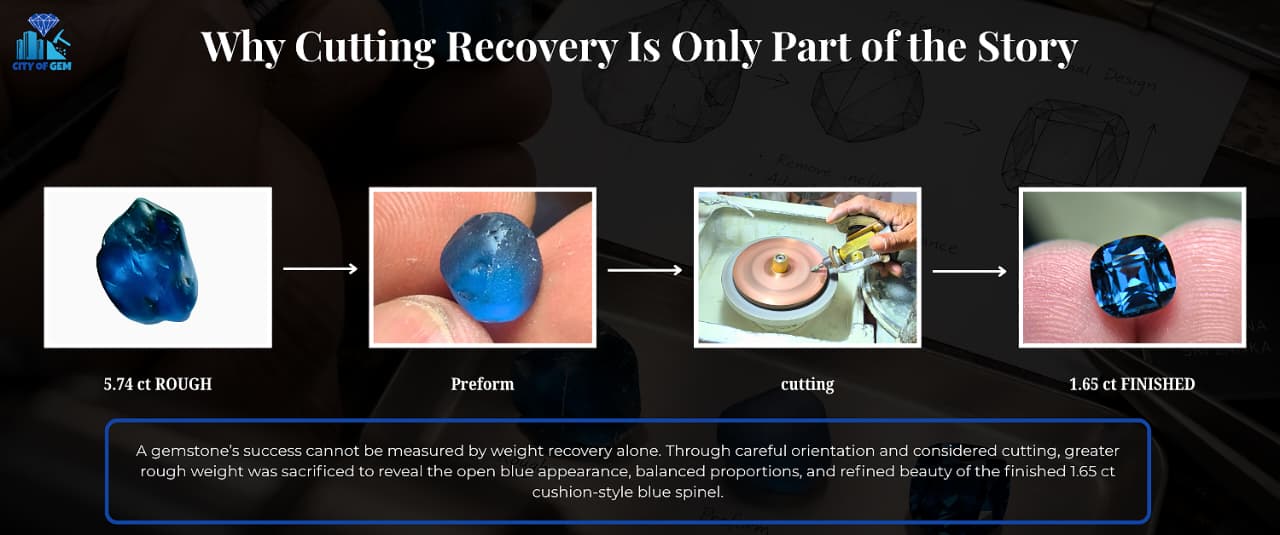
A higher recovery percentage does not automatically mean a better cut, just as a lower recovery percentage does not automatically indicate a poor result. Each rough gemstone presents a different equation involving usable volume, internal characteristics, color, orientation, face-up dimensions, depth and optical performance.
Had we prioritized weight alone, a heavier finished stone might have been possible in a different configuration. But preserving unnecessary depth or following an unfavorable orientation can influence how dark a strongly colored gemstone appears. In this case, we accepted greater weight removal in order to work toward the appearance we wanted from the blue spinel.
The final 1.65 ct cushion-style blue spinel shows why the finished gemstone must ultimately be considered as a whole rather than judged only by rough-to-cut percentage.
From a Rakwana Gem-Hunting Journey to Europe
What makes this project particularly meaningful is the complete journey behind the gemstone. It was not simply a finished blue spinel purchased from stock. The experience began while travelling through Sri Lanka’s gemstone country with our European customer. The 5.74 ct rough was sourced during that journey, brought back for examination, carefully planned, gradually preformed and finally transformed through precision faceting and polishing.
The completed stone now measures 6.6 × 6.4 × 4.6 mm and weighs 1.65 ct, with a rich but more open blue appearance and excellent clarity. From an irregular piece of rough, the cutting process revealed a completely different visual identity.
Finally, the gemstone is ready to continue its journey to Europe.
Experience Gemstone Sourcing With City of Gem
City of Gem’s work is not limited to selling finished gemstones. Our connection with Sri Lankan gemstone source areas allows us to work through different stages of the journey—from sourcing rough material and evaluating cutting possibilities to preforming, precision cutting, polishing, certification support and worldwide delivery.
For customers who want something more personal, selected gemstone-sourcing journeys provide an opportunity to travel with us through Sri Lankan gem areas and experience the sourcing environment firsthand. Customers can participate in the search for rough gemstones and better understand the decisions that happen before a polished gemstone ever reaches a jewelry setting or collection.
It is important to remember that rough gemstones always involve uncertainty. Examination can help us estimate color, clarity, orientation and cutting potential, but the internal structure and final cutting result cannot be guaranteed before the stone is opened and worked. That uncertainty is part of working with natural rough—and part of what makes each successful transformation unique.
This 5.74 ct Rakwana blue spinel rough becoming a 1.65 ct finished gemstone is a good example of the complete City of Gem approach: travel closer to the source, examine the natural material realistically, make cutting decisions around the individual stone, and allow professional lapidary work to reveal the gemstone hidden inside.
From the gem-producing landscapes near the Sinharaja rainforest region, through careful orientation and cutting, to a finished blue spinel prepared for its European owner, this was more than a rough-to-cut transformation.
It was a real gemstone journey.
Frequently Asked Questions
Yes. This project began with a 5.74 ct natural blue spinel rough sourced during a City of Gem gem-hunting journey around Rakwana, Sabaragamuwa Province, Sri Lanka.
The rough was sourced from the Rakwana gemstone-producing area in Sri Lanka, near the Sinharaja rainforest region.
The original blue spinel rough weighed 5.74 ct.
After cutting and polishing, the finished blue spinel weighs 1.65 ct and measures approximately 6.6 × 6.4 × 4.6 mm.
The weight recovery was approximately 28.75%, calculated as Approximately 71.25% of the original weight was removed during trimming, preforming, orientation, faceting and polishing.
The cutting plan was not based on weight retention alone. Areas containing unwanted internal features had to be removed, and the orientation was adjusted to achieve better clarity, proportions and a more open blue face-up appearance.
A round direction was considered and could have produced strong brilliance, but the spinel had a relatively deep blue body color. The cushion-style orientation was selected to help create a more open color appearance while maintaining attractive brilliance and proportions.
The finished gemstone has a cushion-style outline with rounded corners and an octagonal step-style pavilion design.
No. Rough-to-cut recovery depends on the original shape, inclusions, usable depth, color orientation and desired finished design. A successful result should be evaluated by the overall balance of color, clarity, brilliance, proportions, durability and usable face-up appearance—not weight recovery alone.
Yes. City of Gem can arrange selected gemstone-sourcing experiences where international customers travel with us through Sri Lankan gemstone source areas, experience the sourcing environment and participate in finding rough gemstones.
No. Rough gemstones always involve natural uncertainty. Examination can provide an informed estimate of color, clarity, orientation and cutting potential, but internal structures can reveal themselves differently during grinding and cutting, so the final result cannot be guaranteed.
After completing its journey from rough through planning, cutting and polishing, the 1.65 ct finished blue spinel is ready for delivery to its customer in Europe.