
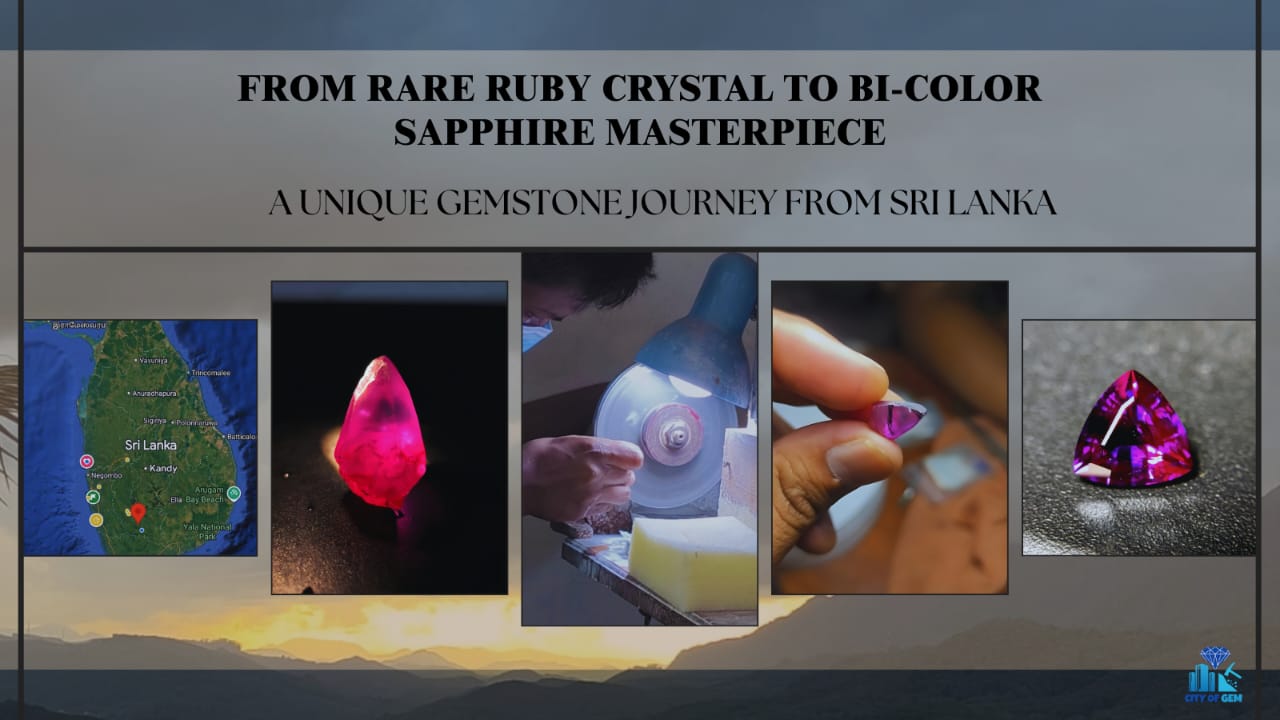
Sri Lanka has long been recognized as one of the world’s most historic sources of precious gemstones. Among its many mining regions, the villages surrounding Ratnapura and Endana have produced remarkable sapphires, spinels, and occasional rubies with fascinating crystal structures. Every once in a while, however, a gemstone appears that tells a much deeper story—one that begins in the earth as a rare crystal and ends as a uniquely crafted gem. This is the story of a 7 carat ruby crystal discovered in Endana village around mining in Sri Lanka, which eventually transformed into a 1.59 carat bi-color sapphire through thoughtful cutting and creative collaboration.
Discovery of the Ruby Crystal
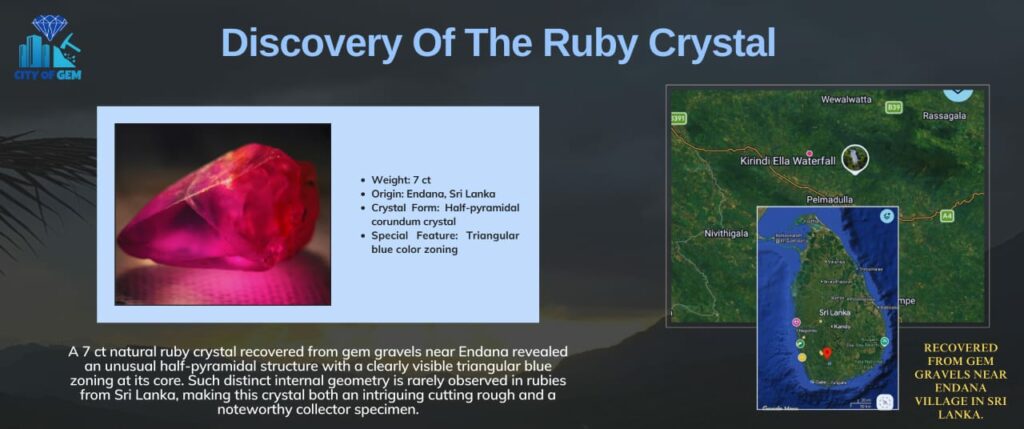
The rough gemstone began its journey as a 7 ct ruby crystal in natural rough form recovered from the gem gravels near Endana village around mining in Sri Lanka. What immediately made this crystal remarkable was its half-pyramidal crystal structure, which is uncommon in corundum crystals from Sri Lanka.
The crystal had a natural triangular geometry and a striking internal feature. Deep inside the center of the crystal, there was a distinct triangular blue zoning, clearly visible when light passed through the stone. This blue triangular core formed almost like a natural geometric pattern inside the ruby crystal.
Such zoning structures are rare in Sri Lankan rubies because most ruby crystals from the island tend to occur in lighter pink to purplish tones with irregular color distribution. Seeing a clearly defined triangular color zone inside a ruby crystal immediately made this piece interesting not only as a cutting rough but also as a collector’s specimen.
Even in its rough state, the crystal attracted attention because Sri Lankan ruby colors are relatively rare compared to sapphire production, making any well-formed ruby crystal from the region a special find.
Structural Challenges in the Rough
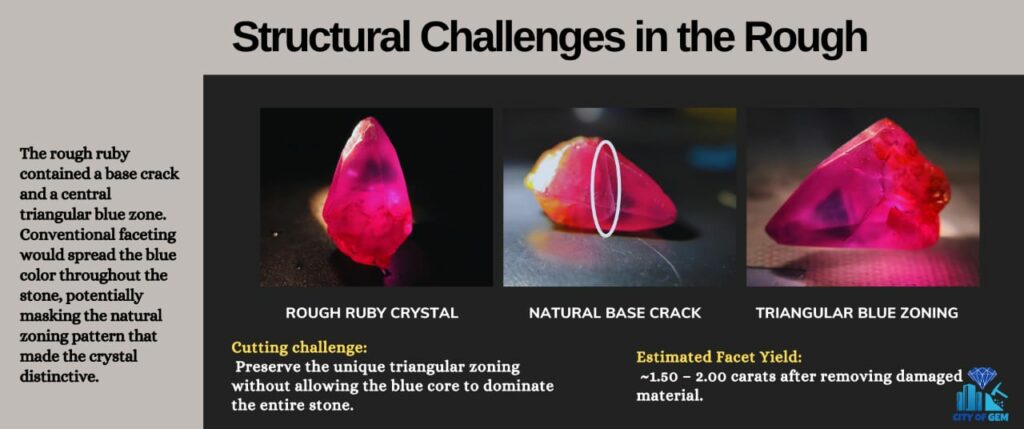
Despite its beauty, the crystal was not perfect for cutting. Examination revealed a natural crack near the base of the crystal, which meant the entire stone could not be preserved in a single cut gemstone. Once the damaged area was removed, the facet-grade portion of the stone was estimated to produce approximately 1.50 to 2.00 carats.
The real challenge, however, was the internal blue triangular zoning. In many gemstones, color zoning can be either an advantage or a problem depending on how it interacts with the final cut. In this particular crystal, the blue zone sat exactly in the center of the triangular crystal structure.
If the stone were cut using a conventional faceting design with a sharp pavilion culet, the blue color would spread throughout the entire gemstone. The resulting gem would likely appear mostly blue with pink or reddish hues, losing the natural zoning pattern that made the rough crystal unique.
Customer Vision and Cutting Strategy
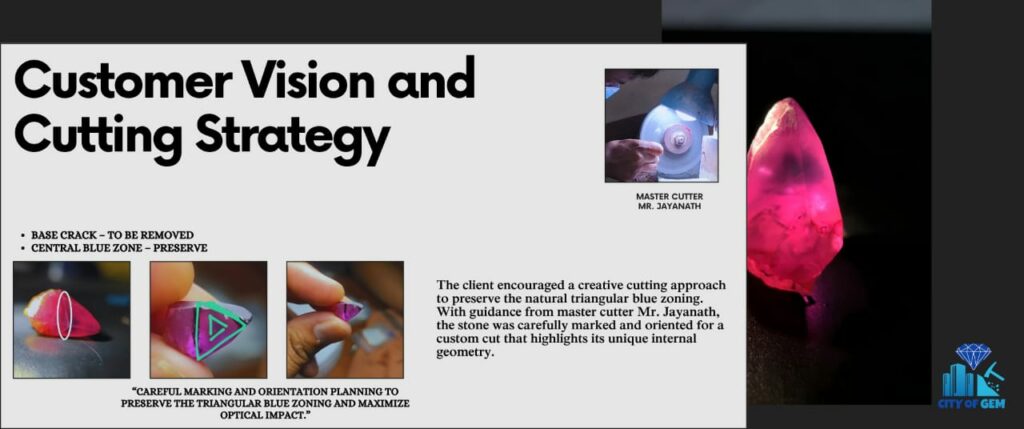
At this stage, one of our customers from Switzerland expressed interest in the stone. Instead of pursuing a standard cutting style, the client encouraged us to explore a creative cutting approach that would preserve the natural color zoning while still removing the crack.
After detailed examination and discussion with experienced gemstone cutter Mr. Jayanath, we carefully marked the stone and planned the cutting orientation. The idea was not simply to cut the stone for maximum weight but to highlight the natural geometry and color structure of the crystal.
The solution was surprisingly elegant.
Rather than creating a sharply pointed pavilion, we decided to leave the culet slightly open, inspired by traditional old mine cutting styles. This allowed the blue color zone to remain concentrated in the center while blending naturally with the surrounding pink tones.
The Result: A Bi-Color Sapphire
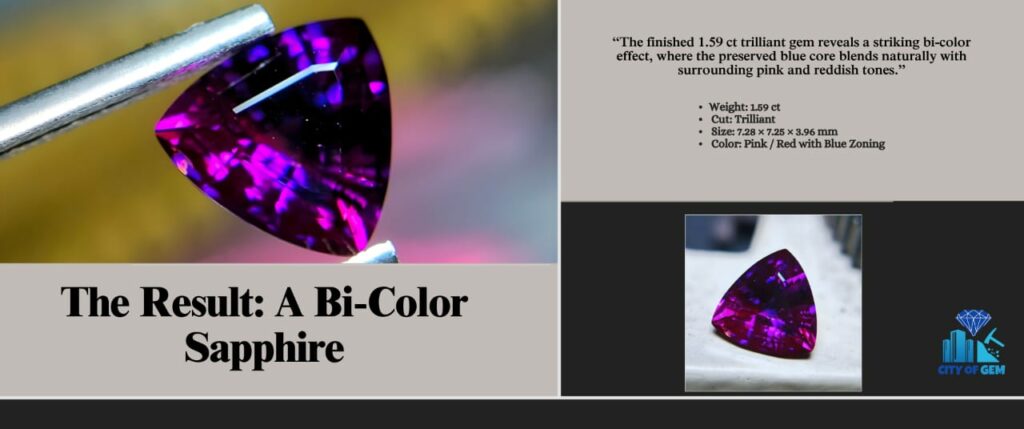
When the cutting process was completed, the transformation was remarkable. Instead of producing a single-color ruby or sapphire, the gemstone displayed an extraordinary combination of colors.
The final gem revealed a vibrant blend of pink, reddish, and blue tones, creating a striking bi-color sapphire effect. The triangular orientation of the stone enhanced the internal zoning, making the blue triangle appear subtly within the pink body color.
The finished gemstone weighed 1.59 carats and was cut in a trilliant shape, measuring 7.28 x 7.25 x 3.96 mm. The cut not only preserved the natural triangular geometry of the crystal but also enhanced the unique color interaction created by the original zoning.
Certification and Final Result
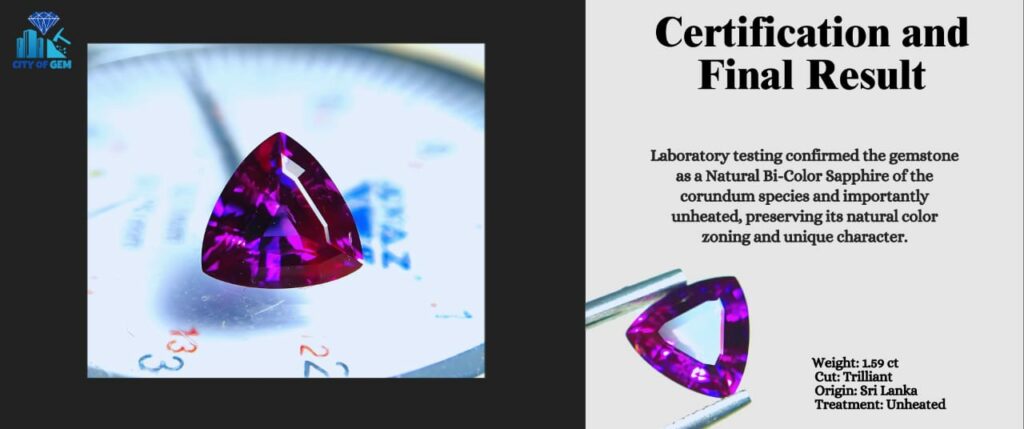
After cutting, the gemstone was submitted for laboratory examination. Certification confirmed that the stone is a Natural Bi-Color Sapphire belonging to the corundum species, and importantly, it was found to be unheated.
Unheated gemstones from Sri Lanka are highly valued because they retain their natural color without artificial enhancement. In this case, the natural zoning and careful cutting resulted in a gem with a truly unique appearance rarely seen in conventional sapphire cuts.
With certification completed, the gemstone is now ready to travel to its new owner in Switzerland, marking the end of its transformation journey.
Crafting Gems with Purpose
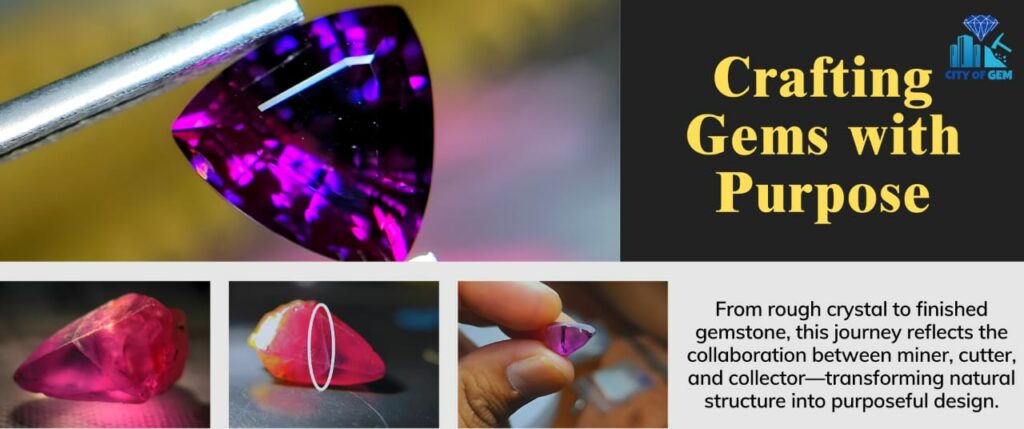
This project demonstrates how gemstone cutting is not merely a technical process but also a creative collaboration between miner, cutter, and collector.
Instead of forcing the crystal into a standard shape, we chose to respect the natural structure of the stone and use it as inspiration for the final design. By doing so, we were able to transform a ruby crystal into something far more unusual—a bi-color sapphire gemstone with a distinctive triangular character.
Moments like these reflect the philosophy behind our work.
City of Gem – where the journey begins from the source.
Frequently Asked Questions (FAQ)
What makes Sri Lankan ruby crystals rare?
Sri Lanka is globally famous for sapphires, but ruby occurrences are much less common. When ruby crystals are found, they often display lighter pinkish colors rather than deep red tones, making well-formed ruby crystals from Sri Lankan deposits particularly interesting to collectors.
Why was the ruby crystal cut as a sapphire?
Ruby and sapphire both belong to the same mineral species—corundum. The difference between them is primarily color. During cutting, the natural color zoning created a blend of blue and pink tones, which gemologically classifies the stone as a bi-color sapphire rather than ruby.
What is color zoning in gemstones?
Color zoning occurs when different trace elements are distributed unevenly during crystal formation. These variations create visible bands or patterns of color inside the gemstone, such as the triangular blue zone seen in this crystal.
Why was a trilliant cut chosen?
The original crystal structure was naturally triangular. A trilliant cut allowed the cutter to maintain the natural symmetry of the crystal while showcasing the internal color zoning in the most attractive way.
Why leave the culet open during cutting?
A sharp culet can cause internal colors to mix completely within a gemstone. By leaving the culet slightly open, similar technique to traditional old mine cuts, the cutter was able to preserve the central blue zone while blending it with the surrounding pink hues.
Is an unheated sapphire more valuable?
Yes. Many sapphires on the market are heat treated to enhance color or clarity. An unheated sapphire retains its natural color, which often makes it more desirable to collectors and gemstone enthusiasts.
Where was this gemstone mined?
The rough crystal originated from Endana village around mining in Sri Lanka, one of the traditional gem-producing areas known for producing sapphires and other corundum varieties.
What is special about bi-color sapphires?
Bi-color sapphires display two distinct colors within the same gemstone. These stones are highly attractive because they showcase the natural geological processes that occurred during crystal growth millions of years ago.